
Originally published by MSN on May 29th, 2024

The machines are humming again at the old paper mill in Madison. Workers carefully tend them, monitoring the production and quality.

But unlike the days of giant paper machines, there are no harsh chemicals in use, no smell permeating the mill, and seemingly little leftover waste.

And, of course, no huge rolls of paper.

Instead, TimberHP is producing building insulation, made from wood chips.

“I love the product,” Matt O’Malia, one of the co-founders of TimberHP, said.

He and Josh Henry began working on the project eight years ago, looking for what they consider a better way to insulate buildings, with a product that is renewable, recyclable, and what they see as carbon-negative. And one where the raw materials come from Maine and are processed into the finished product here as well.

O’Malia, an architect who specializes in energy-efficient buildings, and Henry, a chemist with strong interest in renewable energy, teamed up to develop a building insulation alternative to foam, fiberglass, and mineral wool—the most commonly used materials.

They found it in Europe, where wood fiber insulation has been manufactured and sold for several decades.

“And it had everything we were looking for,” O’Malia explained. “It was renewable, recyclable, made from the waste stream of the lumber industry … and it was carbon negative, given that it’s made from wood with minimal process energy.”

“When we saw this product in Europe, it just immediately made sense,” Henry said. “We structure and sheathe our houses in wood. It makes all the sense in the world we would insulate them with wood as well.”

They decided shipping the product from Europe to the U.S. in large enough quantities did not make economic sense, so they started research and development on their own, with the help of the University of Maine’s Advanced Structures and Composites Center. Then, say the two partners, they tried to interest U.S. manufacturers in making the product, but found no takers.

So, the architect and the chemist became manufacturers themselves.

With early financial help from Maine economic development agencies, and eventually private investors, they bought the former Madison paper mill, installed new equipment to handle and process the chips, and hired a workforce.

That staff includes a number of people who formerly worked at the paper mill but had moved to other mills or jobs when it finally closed four years earlier.

“Great for the town, great for the community, “ senior engineer and Madison resident Tim Worster, who had worked in the old paper mill for 19 years, said.

Josh Henry, who is CEO of TimberHP, said seeing those workers come back to Madison has been one of the best aspects of the new venture. 

“That’s one of the biggest wins, we had a number of our team members worked here 20, 30 years,” he said.

Those workers knew the electrical and other systems still in the mill, which he said was a major help in renovating it to manufacture the new products.

There are currently 14 types or sizes of wood fiber insulation being made at Madison. This includes bags of the fiber made to be blown into wall or ceilings, a technique called “dense-pack” that is typically done with cellulose.

Henry and O’Malia say the wood fiber insulation provides a bit higher R-value and is cost competitive.

The other form of insulation currently in production is made in batts— thick pieces, formed by pressing the fibers together, designed to be fitted into wall cavities inside homes. The founders say TimberHP’s batts price is competitive with the fiberglass or mineral wool batts familiar to the market, and are also competitive in terms of price and R-value.

Price, said O’Malia, was a significant factor in the development.

“And that’s something I learned early on, in terms of sustainability and construction, in my work as an architect,” he explained. “You can have a great sustainability concept, but if it comes at a high cost premium, only a very few will bother to invest in it. So, if you really want to move the needle, really have an impact, you have to figure out how to be cost competitive and have the benefit of carbon storage, renewable, recyclable, and just a better material.”

Both men say they have so far seen a lot of interest from builders in the new product and are finding acceptance from the lumber and building materials industry as well.

“Hancock Lumber. Viking Lumber, Ware- Butler, Hammond Lumber,” Henry said, naming the most prominent Maine lumber and building material dealers.“(Companies) throughout the northeast that understand the product have seen it in Europe and are waiting to get it in their hands.”

TimberHP says it had strong interest from the large national home builder D.R. Horton, and has just announced a “collaborative partnership” agreement with the large French building material manufacturer Saint-Gobain, owner of the prominent U.S. brand CertainTeed. According to a press release, that agreement will let CertainTeed be one of the U.S. distributors of TimberHP insulation and will have Saint-Gobaine be the exclusive distributor in Canada.

In the press release from the two companies, Josh Henry called the agreement “a huge vote of confidence” in the TimberHP product and their team.

For its part, Saint Gobaine called the deal “a welcome addition to Saint-Gobaine Canada’s light and sustainable construction portfolio.”

TimberHP said it currently employs about 70 people in Madison, but the company has plans to double the mill’s capacity and double the workforce.

Originally published by Business Wire on May 28th, 2024

MALVERN, Pa.–(BUSINESS WIRE)–Saint-Gobain, through its building products subsidiary CertainTeed Inc., and TimberHP, a manufacturer of insulating wood composites, today announced that they have entered into a collaborative relationship, which will enable CertainTeed to distribute TimberHP’s wood fiber insulation products in North America, including as the exclusive distribution partner in Canada. Executed in close collaboration with NOVA by Saint-Gobain, the company’s venture arm, this partnership will continue to drive Saint-Gobain’s vision to be the worldwide leader in light and sustainable construction and will improve its own sustainable offerings and readiness to respond to customer needs.

TimberHP, located in Maine, is a startup company that grew out of a partnership between two entrepreneurs—Matthew O’Malia, an award-winning architect with a reputation for developing high-performance, cost-competitive designs; and Dr. Joshua Henry, a materials chemist with years of experience elevating solutions to conserve energy and produce renewable energy. They utilize residual wood chips and hydroelectricity to manufacture nature based sustainable insulation solutions from wood fiber, which aligns with Saint-Gobain’s global sustainability goals. When fully launched, the offering will include loose fill, batt, and rigid board insulation products.

“Driven by our Purpose of Making the World a Better Home, this exclusive partnership with TimberHP enhances the sustainable solutions we are bringing to our stakeholders throughout Canada,” said Julie Bonamy, Chief Executive Officer, Saint-Gobain Canada. “This is a welcome addition to Saint-Gobain Canada’s light and sustainable construction portfolio, which will further our vision to provide a full offering of building materials and solutions to our customers.”

“It is a huge vote of confidence in our technology and our team at TimberHP to partner with a brand as innovative and impactful as CertainTeed,” said Joshua Henry, Chief Executive Officer of TimberHP. “It is essential that we mold the future of construction to be exceptionally easy, effective, energy-efficient and sustainable, and we look forward to addressing those industry needs together.”

This exciting partnership comes as Saint-Gobain continues its commitment to growth and sustainability in North America. Last month, the company announced its third major acquisition in Canada in the last two years with its intent to acquire The Bailey Group of Companies, a leading Canadian manufacturer of commercial metal framing and building solutions. In addition, work is currently underway to upgrade equipment at CertainTeed Canada’s gypsum wallboard plant outside of Montreal, which will transition the plant away from fossil fuels to being powered by hydro-electricity, creating North America’s first and the world’s largest zero carbon production drywall plant (Scopes 1 and 2 emissions).

With TimberBatt and TimberFill products already available in the United States, CertainTeed and TimberHP are working closely to bring these solutions to the Canadian market in the near future.

About TimberHP

GO Lab, Inc. (dba TimberHP) is a manufacturing company that produces thermal and acoustic wood fiber insulation products for the residential and commercial construction market. Located at its Madison, Maine facility, TimberHP is the first—and only—company to manufacture insulating wood fiber composites in North America, building on a successful 20-year history of production in Europe. TimberHP insulation is manufactured from sustainably produced wood chip residuals, and is a high-performing, cost-competitive, scalable, renewable and carbon sequestering alternative to existing market solutions. When operating at full capacity, TimberHP Madison will produce almost 20 tons of product an hour, utilize over 250,000 green tons of softwood residuals per year, generate $168 MM of revenue, and employ 144 people.

About CertainTeed

With innovative building solutions made possible through its comprehensive offering of interior and exterior products, CertainTeed is transforming how the industry builds. As leaders in building science and sustainable construction, CertainTeed makes it easier than ever to create high-performance, energy-efficient places to live, work and play, so that together we can make the world a better home.

A subsidiary of Saint-Gobain, one of the world’s largest and oldest building products companies, CertainTeed has more than 6,900 employees and more than 60 manufacturing facilities throughout Canada and the United States. www.certainteed.ca

About NOVA by Saint-Gobain

NOVA, the external venture arm of Saint-Gobain, identifies forward-thinking startups around the world whose philosophies align with Saint-Gobain’s focus on sustainability and digital. It helps those startups nurture their ideas and grow their companies to scale through partnerships and investment. With a presence in Asia, Europe and North America, NOVA by Saint-Gobain connects the global startup community with the power, resources, and experience of Saint-Gobain to address the needs of today and challenges of tomorrow. Learn more by visiting https://www.nova-saint-gobain.com and www.saint-gobain.com.

About Saint-Gobain

Worldwide leader in light and sustainable construction, Saint-Gobain designs, manufactures and distributes materials and services for the construction and industrial markets. Its integrated solutions for the renovation of public and private buildings, light construction and the decarbonization of construction and industry are developed through a continuous innovation process and provide sustainability and performance. The Group’s commitment is guided by its purpose, “MAKING THE WORLD A BETTER HOME”.

€47.9 billion in sales in 2023
160,000 employees, locations in 76 countries
Committed to achieving net zero carbon emissions by 2050

Originally published by This Old House May 9th, 2024

Watch the full episode where TimberHP is featured, A Breath of Fresh Air, for free.

The two primary suites, to accommodate multigenerational living in the 1887 Victorian home, are taking shape, and the first-floor foyer is opened up, highlighting the new wide staircase, which was prefabricated offsite and installed in just a few hours.

Tom Silva visits the local mill shop where the stairs were fabricated and gets a tour of the process from shop owner Nick Veenstra.

Meanwhile, homeowner Jason and his parents are adding curb appeal to the house by installing a new brick walkway. Jenn Nawada lends a hand before speaking with paver expert Doug Rose to learn about different types of pavers and how they are used.

On the interior, fire, mold, and mildew-resistant wood fiber insulation is used in the walls. Builder Zack Dettmore demonstrates its fire-resistant property and walks through the application process.

In the basement, HVAC contractor Chris Wisniewski explains the difference between a heat recovery ventilator (HRV) and an energy recovery ventilator (ERV) and why he chose to use an HRV in this project.

Kevin O’Connor meets up with architect Dan Kopec at a local millwork supplier to talk about period trim details and the rules of classical architecture that guide scale and profile choices.

My partner likes to take long showers (I’m talking 45 minutes+) which often means that even with the fan running our mirror is fogged and our walls are damp long after he exits the bathroom. This was all fine and dandy until we started noticing little black splotches on our ceiling… particularly right above the shower. No matter how hard we tried to clean and bleach them away, the mold kept coming, forming a distinct rectangle on our ceiling. We decided to investigate and discovered that the rectangle was a drywall patch placed over what must have once been a chimney vent in our 1900s home—basically, an uninsulated hole that went straight to our roof. Safe to say it’s now properly insulated, drywalled, and repainted, and we haven’t seen a spot since!

Steamy bathroom, wood counter with white bowl sink

There are a lot of reasons you might consider insulating bathroom walls in your home; mold and mildew prevention being one of them. But there are also cases where bathroom insulation isn’t necessary. We’ll cover all the incentives for bathroom wall insulation, when you can skip it, and how to choose and install the right insulation for your home and climate.

6 Reasons to Install Bathroom Insulation

  1. Moisture Control: As my partner clearly demonstrates, bathrooms are prone to high humidity, which can lead to condensation within walls and eventually to mold and mildew growth. And it might not always be as visually apparent as it was in our bathroom. In fact, the hidden damage mold, mildew, and rot can do to your home’s framing is worse than the spots on your paint. If left untended, you can end up with structural damage and costly/disruptive repairs. Proper bathroom insulation can prevent moisture from penetrating walls and causing these issues and improve your indoor air quality.
  2. Temperature Regulation: It’s no fun to step out of a luxurious, hot shower and immediately find goosebumps on your skin because your bathroom is cold. Likewise, a cold shower does little good in summer if your bathroom is sticky and hot. Bathroom wall insulation, especially for any exterior facing walls, can help maintain a comfortable and consistent temperature.
  3. Energy Efficiency: Your bathroom may be a small portion of your home’s overall footprint, but if it has exterior walls lacking high-quality insulation, it may be a source of energy loss. Increase your home energy efficiency and save on heating and cooling costs by adding appropriate bathroom wall insulation.
  4. Noise Reduction: Say your bathroom shares a wall with a bedroom or common area like your living room—the sounds of the toilet flushing or the shower running aren’t exactly conducive to creating peaceful and private spaces. One of the biggest benefits (and most common motivations) of bathroom insulation is its ability to reduce noise.
  5. Protect Plumbing: If you live in a colder climate, lack of bathroom insulation bears the risk of pipes freezing, which can burst and lead to extensive water damage. Keeping your bathroom temperature regulated with proper insulation also has the benefit of protecting your plumbing.
  6. Take Advantage of Renovation: In 2020, bathroom remodels made up 30% of total home renovations and homeowners are setting increasing budgets for their bathroom makeovers. So, if you’re planning to revamp your bathroom, you’re not alone. Not only is this a convenient time to add bathroom wall insulation, but it may also be necessary to comply with building codes. Check your local state and city regulations to find out if insulating bathroom walls is a requirement for your remodel project.

When is Bathroom Insulation Not Necessary?

We can sing the praises of proper insulation but it’s important to note that insulating bathroom walls isn’t always necessary or practical. If your bathroom is located within your home’s conditioned space and only shares walls with other interior rooms, bathroom insulation may not be a top priority. If your bathroom is already surrounded by heated or cooled spaces, you can likely skip this insulation project. In some cases, you may still decide to insulate bathroom walls for soundproofing.

No matter what, you should always consider important factors like your local climate and the specific construction of your walls before choosing to insulate.

How to Insulate a Bathroom

If you’ve made it this far, that probably means you’d like to add bathroom insulation and want to know how! For competent DIYers, insulating bathroom walls is a manageable project to take on without professional assistance. Start by choosing the best bathroom insulation for the job.

bathroom walls stripped to studs

Historically, spray foam has been a popular choice of bathroom insulation as it is water-resistant and good for sealing drafts, but it requires professional equipment to be installed properly. For DIY bathroom wall insulation, rigid polystyrene foam sheets are easy to install. Unfortunately, the manufacturing of foam boards releases dangerous hydrocarbons into the air which can contribute to global warming and be hazardous to human health.

Wood fiber insulation is a great alternative, being equally safe and easy to install with the added benefit of arriving at your home carbon negative. This new insulation technology is made from the wood waste of lumber yards and sustainable forest management practices, making it a fully renewable, carbon-storing option for sustainably minded homeowners. It is naturally moisture-managing and mold-resistant thanks to the addition of borate. Plus, wood fiber insulation is designed for unmatched sound-deadening to create quiet in your most private spaces. It’s also available at multiple thicknesses, such as 3”, perfect for interior wall applications.

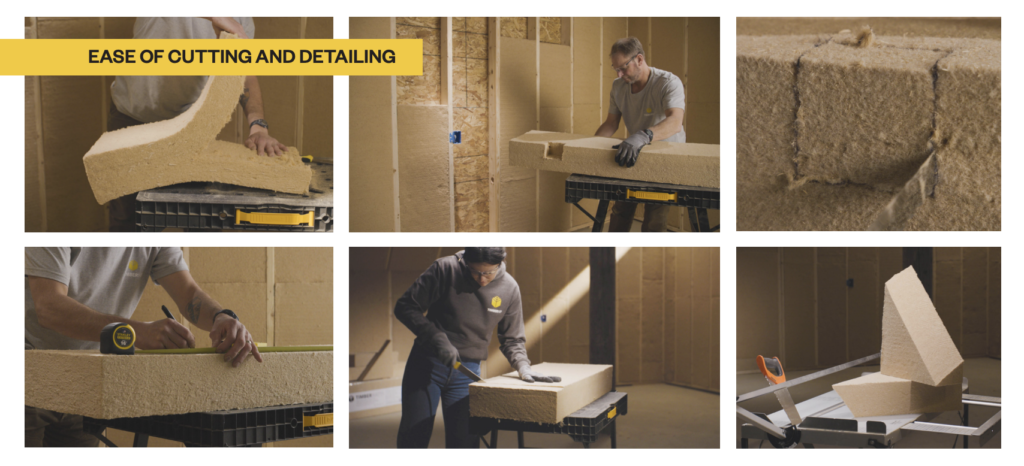
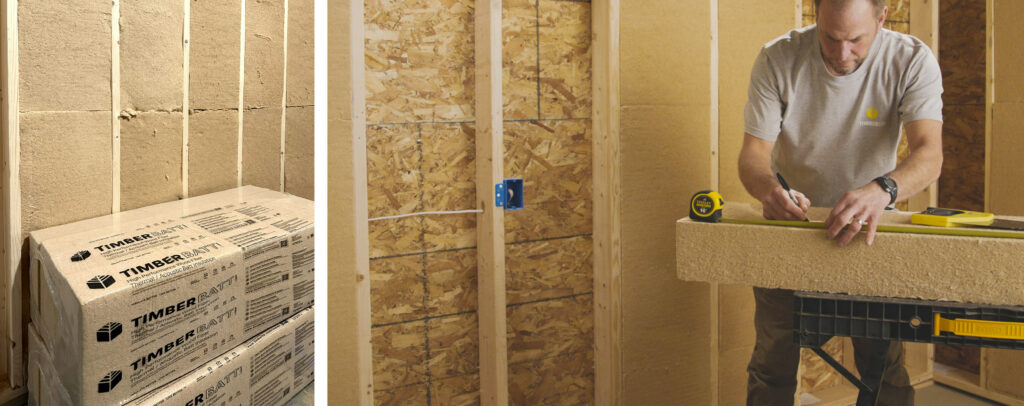
For the sake of this guide, we’ll assume your bathroom has been gutted and any walls you plan to insulate are stripped to their studs. Installing wood fiber bathroom insulation is easy. Use a utility knife to cut your batt to the correct size (remember, measure twice, cut once!) and then use your hands to press it between the studs for a snug fit. You can easily cut or tear wood fiber batt to fit around wiring and pipes, ensuring there are no gaps in your bathroom insulation. Check out our DIY guide for more details on prepping and installing batt insulation.

Bonus: Proper Ventilation & The Right Paint

While insulating bathroom walls is a great first step to managing bathroom moisture, preventing mold, maintaining comfortable temperatures, and reducing noise between rooms, your work doesn’t stop there.

Primarily, you need to ensure your bathroom has adequate ventilation to prevent the build-up of moisture. Your bathroom fan should be sized according to size of the room, with the rule of thumb that you need 1 cfm for every square foot of floor area in your bathroom. When possible use durable metal or PVC duct work to vent your fan and try to run ducts as short and straight as possible.

Windows can also offer natural ventilation but without airflow, tend to be less effective—plus someone has to remember to open and close the window. You should also keep an eye on your bathroom windowsill as condensation on the glass can roll down, collecting at the base and causing mold or rot in your window frame. Give these windows a good clean and check your frame every so often.

Your paint choice also has an impact on how your bathroom walls respond to moisture. In high-traffic bathrooms, a semi-gloss finish is easy to wipe and repels moisture, helping you keep your walls clean and dry. Powder rooms or guest bathrooms might be amenable to eggshell or satin finishes that can still be wiped but prefer not to be exposed to frequent moisture.

With every long, steamy shower my partner takes that doesn’t leave behind a trace of mildew, I’m reminded of the important role of our bathroom insulation. Investing in quality bathroom insulation is an opportunity to enhance your quality of life, one foggy mirror at a time.

When it comes to insulating your home and achieving energy efficiency, choosing the right material is key. Batt insulation has long been a go-to for its ease of installation and effectiveness in interior walls and ceilings. It comes in various types, from fiberglass to mineral wool, and more recently, the game-changing wood fiber insulation. Importantly, motivated homeowners can DIY installing batt insulation with the right tools and steps. If you count yourself among these, we can guide you on how to select and source materials, how to cut batt insulation and properly install it in your space.

Types of Batt Insulation

While fiberglass batts have been the industry standard due to their low cost and wide availability, they come with downsides such as potential lung irritation and over-compression. To safely install fiberglass batt insulation, you must wear a dust mask and safety glasses, but even with these precautions, glass fibers can cling to clothing or drift into other parts of your home. Mineral wool is similar in its risks to your health but is also known for its fire resistance and soundproofing abilities. Mineral wool batt insulation is typically more expensive than fiberglass.

However, there’s a new player in town that is gaining popularity among DIYers for good reason – wood fiber batt insulation. Competitively priced between fiberglass and mineral wool and free from abrasive fibers, it’s a DIYer’s dream. For maximum comfort while installing. consider wearing a dust mask or safety glasses when performing overhead work. Cut-resistant gloves are always recommended when cutting batts, but long-sleeves are not needed due to the absence of irritating fibers in wood-fiber insulation. It’s flexible and semi rigid, making it easy to handle and install for homeowners. The high density, interlocking fibers can be torn vertically to install around wires in wall cavities and make for clean and precise cuts with a simple serrated knife. And like mineral wool, wood fiber is a superior acoustical batt insulation, absorbing sound to bring serenity to your home. Its natural composition doesn’t just insulate; it also regulates humidity, contributing to a healthier home environment.

Perhaps our favorite part: wood fiber batt insulation arrives at your home carbon negative and will continue to store carbon throughout the lifetime of the building. Made from the natural waste chips of the lumber and forestry industry, it is renewable, fully recyclable, and supportive of a more sustainable forest economy.

But enough said, you want to know how to install batt insulation in your home.

Preparing to Install Batt Insulation

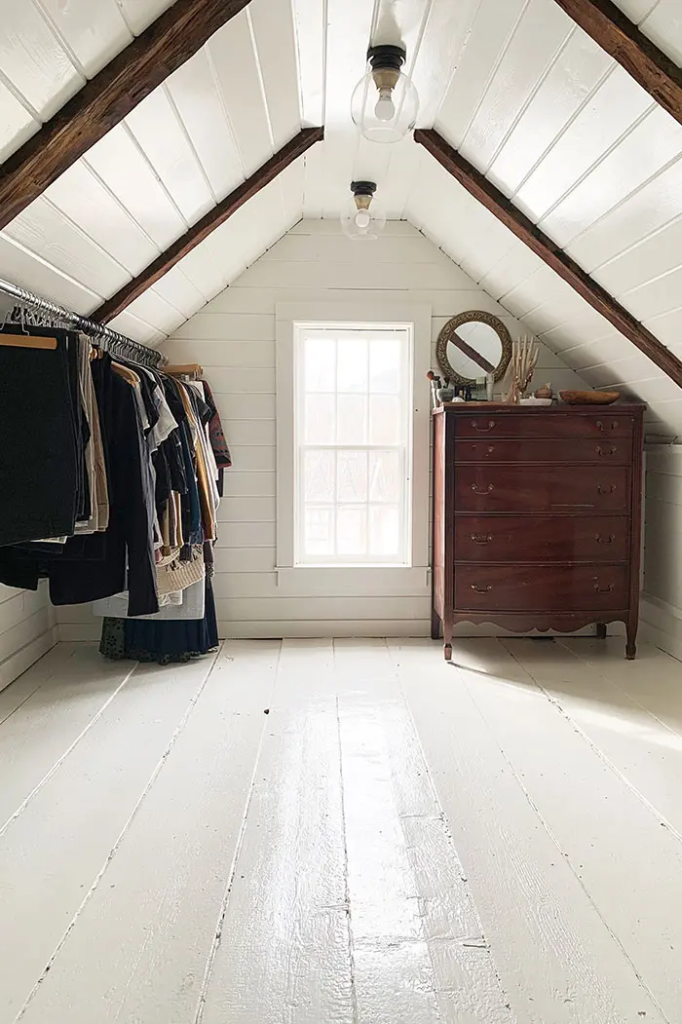
While most insulating happens when your home is being built, there are plenty of common reno projects that offer a great opportunity to improve your home’s energy efficiency with upgraded batt insulation. Let’s imagine you’re turning your attic into a semi-finished space—nothing fancy, just some room for a reading nook or some arts and crafts space for your kids—and you want to ensure it stays warm in the winter and cool in the summer. Even if you don’t plan to spend a lot of time up there, your roof is a major pathways to heat loss, so investing in insulation there can make a big difference in your heating bill.

Before you begin your insulation project, you’ll need to source your materials. Check out TimberHP’s distributor list to find a local supply store that stocks wood fiber batt insulation.

How Much Batt Insulation Will I Need?

Get out the measuring tape! To avoid overspending on excess insulation or underbuying and needing to order more halfway through the project, it’s important to take accurate measurements of your space before you order your insulation. Start by measuring the depth of your framing – whether they’re wall studs, ceiling joists, or rafters, to gauge the thickness of batt insulation you’ll need. Then measure the width between each framing member. TimberBatt ranges in thickness from 3” to 7.25”, and is available in widths sized for 16″ or 24″ o.c. wood framing. Count the number of cavity bays you will need to fill and measure the length of the space that needs insulating. Use these measurements to determine the total square footage you will need to cover and remember that batt insulation can always be cut or trimmed to fit your unique space.

Tools for Installing Batt Insulation

In addition to the batt insulation, you’ll need a few simple tools to get the job done. In fact, you may already have many of these items in your house:

  • Tape Measure
  • Straight edge or T-square
  • A soft-fiber saw or knife

Having the right knife makes all the difference! Our favorite tools are the Bahco Insulation Saw, our Custom TimberBatt Knife, or the Linzen Insulation Knife. Other insulation knives with large scalloped blades may also work well, but you may find cutting to be difficult with the red-handled mineral wool batt knife. Check out this Cutting Demonstration on Instagram to see our recommended knives in action!

You may also want a putty knife to help ensure the edges of the batt insulation are flush with the studs.

Preparing Your Space

The last step before you begin installing batt insulation is to prep your space, in this case an attic. Clear the area of any personal items, debris, and old insulation. Keep your eye out for stray nails or screws and inspect the joists for any pointy protrusions so that you can be aware of them when installing. Once everything is clean, you’re ready to go.

How to Install Batt Insulation

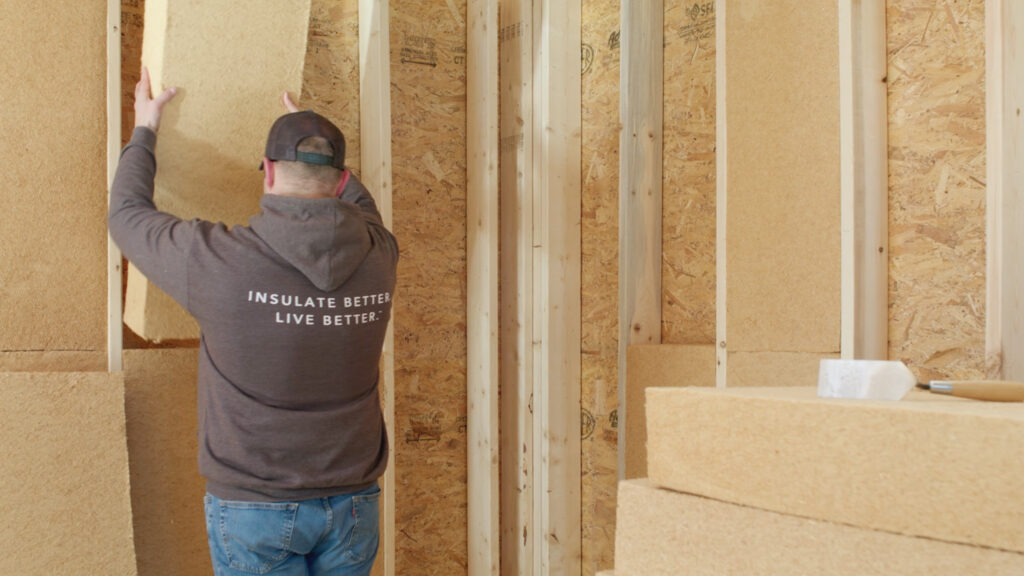
Position the wood fiber batt insulation between the studs and push to fill the cavity. Unlike with fiberglass, pressing wood fiber batt will not compress it and reduce its insulating effectiveness so don’t be afraid to push it in for a good fit. If you’ve chosen the correct width, the batt insulation should form a friction fit between joists.

While less likely to encounter in an unfinished attic, there may be electrical wiring or pipes you need to work around. If the wiring runs perpendicular to the batts, you can use your hands to gently tear the batt vertically and fit it around either side of the wires, or you can cut the batt down the middle with your insulation knife or saw.

For pipes, you’ll need to measure their diameter so that you can make appropriate cuts in the batt to accommodate them. Lay your batt on a flat surface and mark the area you’d like to cut with a permanent marker. Use your insulation knife to cut a cavity in the batt. For vertical pipes, you may need to split the batt in half and fit each piece on either side.

Ensure that your batt insulation does not come in direct contact with any non-insulated recessed lighting or chimneys to avoid potential fire hazards. Use scraps to fill in any remaining gaps or cracks. If there are any areas are over-compressed, you can use a putty knife to pull the edges of the batt out so they are flush with the joists.

Optional: Finishing the Wall

If your goal is just to add energy efficiency to your home and keep the temperature of your attic regulated, you can stop here. If not, the next step might be to install your choice of wall covering, either drywall, beadboard paneling, or some simple canvas sheeting to make the space look clean. There are many great resources for DIY drywall installation on the internet that can help you complete your attic transformation. From there, the attic is your oyster! Paint, add décor, furniture and more.

Bonus: Additional Attic Insulation

If you don’t plan to actively use your attic for storage or living space, you can take your insulation a step further with additional batt insulation or loose fill. If your attic doesn’t have an existing subfloor, batt insulation can also be used to fill joists here. You can also opt for a blown-in solution to appropriately cover the attic space and provide extra thermal barrier to your home. Check out our cost benefit analysis of insulating an unfinished attic for more information on how these steps can benefit your home energy efficiency.

When taking this route, it’s important to properly vent behind the insulation to avoid moisture issues. You will need a class 2 vapor retarder such as unfaced expanded or extruded polystyrene, asphalt coated paper, plywood, or Bitumen-coated kraft paper which reduces the rate at which water vapor can move through your insulation. The best way to ensure maximum energy efficiency in your home is to consider proper insulation from the ground up, but the DIY-friendliness of wood fiber batt insulation makes it ideal for many home projects like bathroom remodels, finishing basements, and other major home renovations and additions. Feel free to reach out to our team of experts whether you’re looking to do-it-yourself or find an installer to bring sustainable, wood fiber insulation into your home design.

Originally published by Mainebiz on March 18th, 2024

PHOTO / FRED FIELD
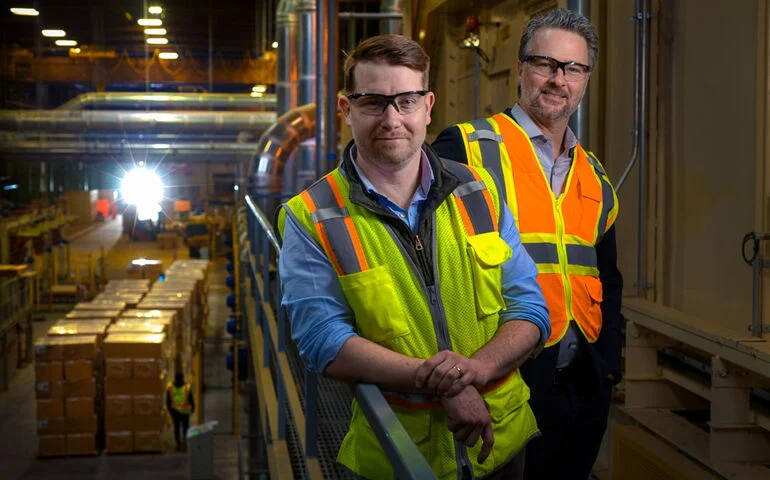
Joshua Henry, co-founder and president, front, and Matthew O’Malia, co-founder and vice president, converted the dormant Madison mill for use by TimberHP, which manufactures wood-fiber insulation.

A defunct paper mill in Madison returned to life in 2023 with a new mission and new technology, but the rebirth had been in the works for nearly a decade.

The plant’s new product, wood-fiber building insulation, has been around even longer — though only in Europe.

All of which makes TimberHP a young company with a long history. That’s fitting for a business innovating within a heritage Maine industry like forest products. TimberHP is the brainchild of Joshua Henry, a trained chemist, and business partner Matthew O’Malia, an architect. The two teamed up in 2015, and eventually bought the mill property in Madison for $1.4 million in 2019.

Today, TimberHP has two forms of high-performance, sustainable insulation in the market, and is now launching a third. The company employs more than 70 people in Madison, and expects to hire more.

Mainebiz: What was the single biggest challenge you faced in the early days?

Joshua Henry: For me it was just the continuous rejection. We had this great solution, but the feeling from the investor community initially was that Matt and I were maybe not the right people for the job. You can only raise so much money from your friends and family. But thankfully, as we continued to grow the company, that concern faded.

Matthew O’Malia: Financing, financing, financing.

To begin with, TimberHP is an industrial startup, which itself is very rare. Then, halfway through our fundraising, we were thrown into the pandemic. We overcame the challenge with the support of an incredible fundraising team, and broad support from the state of Maine, the town of Madison, the logging and lumber industries, and many individuals across the state.

MB: How important was repurposing the Madison mill in your initial plans?

MO: The mill was key to the project’s viability. Not only the building, but the talented people who ran it, who joined our team — and the people of the town of Madison. When we bought the mill, the paper-making equipment was being removed. The timing was fortunate, because we were able to preserve the value of the infrastructure, which represented a major savings.

MB: As you mentioned, the pandemic changed your plans. How did you respond?

JH: We had financing in place that looked probable to close in May 2020, and our largest investor was going to be a multinational corporation based in Europe. Matt and I were there, finalizing details, but had to leave immediately.

There is no doubt that the pivot we had to make — to a much larger financing, underwritten by a tax-exempt bond — is a better approach. It allows us to access a much larger market and has more favorable returns for our investors.

MB: As you look back at the past nine years, what have been the most rewarding aspects of the TimberHP journey?

JH: I just love the people I work with. I am so grateful to our investors and to the Maine forest products industry for embracing us. I think our products are going to make a meaningful difference in the world and help make the lives of builders and our customers better. I know all of this isn’t something everyone gets to experience, so I find gratitude there.

MO: For me this has been a story about trying to create a solution for the next generation of sustainable buildings, and how that can actually be a driver for opportunity and economic growth in rural communities — while supporting renewable, natural resource-based economies.

MB: Where do you see the company going in the next nine years?

JH: Right now, we’re just focused on Madison being a thriving, successful mill, but I suspect we will have additional facilities across the country. The need to improve the energy efficiency of buildings in a sustainable way is just huge. And the fact that we can reinvigorate the forest products industry and support the growth of other rural economies is kind of irresistible.

But Madison will always be our birthplace and our home.

MB: What advice would you offer another company that’s innovating in a legacy industry?

JH: Be resilient. There have been many times when Matt and I have hoped a big investor would come in and fund us in a way that would make this easier. But our investors and team have been extremely committed and understanding, and have stuck with us. The great thing is, that only strengthens our resolve to reward their belief.

MO: Be open to collaboration, diverse ideas and abilities that can unlock opportunity.

Originally published by LBM on March 14th, 2024

As homebuilders and developers respond to a national housing crisis, they find product shortages, now with fiberglass and mineral wool insulation, hindering their momentum. Maine-based TimberHP is countering this lack of supply with the launch of TimberBatt, a high-performance, press-fit cavity insulation for residential and light-commercial construction.

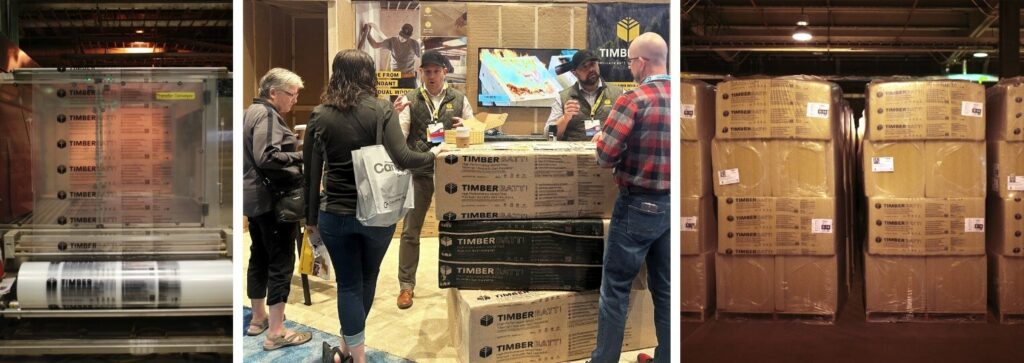
TimberHP selling TimberBatt at the Cameron Ashley Building Products Dealer Show in February.
TimberHP’s TimberBatt being installed into walls.

TimberBatt manufacturing starts with wood chips leftover from lumber production and sustainable forestry operations. This abundant, renewable feedstock is steamed, mechanically refined, and then blended with borate to create wall, floor, and ceiling insulation that resists mold and guards against fire (ASTM E84 Class A).

“Dry-process wood fiber insulation has been produced in Europe for over 20 years and accounts for $1 billion in sales annually in the EU,” said Joshua Henry, TimberHP President and CEO. “The technology and formulation used to create TimberBatt is well established.  We’re just the first to make this type of insulation in North America.”

TimberBatt, with its high density, excels in both thermal and acoustic applications. Its R-value of 4+ per inch combined with high heat capacity and low thermal conductivity make it an insulation for all seasons, defending against winter cold and summer heat gain. TimberBatt’s vapor-open and hygroscopic characteristics work to manage humidity in the built environment. It can contribute to the creation of healthy indoor air while supporting resilient wood frame assemblies. It is also free of itchy fibers, safe to handle and install, and easy to cut and detail. 

“It’s sold at a cost premium in Europe. Here, we’re providing it as a better performing option that is cost competitive with other mainstream insulations. And it’s carbon negative. For decades, we’ve been using insulations made from petroleum, like foam, and with high embodied carbon, like mineral wool, to reduce operational energy use in our buildings.  That contradiction was a driving factor for us to start producing wood fiber insulation in the U.S.,” said Henry.

At full production, TimberHP in Madison will manufacture over 20 million cubic feet of TimberBatt per year which is equivalent to nearly 7,000 semi-trailer loads. Leveraging a strong relationship with their national distribution partner, Cameron Ashley Building Products, TimberHP is currently offering TimberBatt, and their blow-in insulation TimberFill, to customers across the country.

With our nation’s wood baskets seeking a new destination for residual wood chips and the demand growing for scalable insulating materials to support new housing options, TimberHP is already eying locations for additional production facilities.

Originally posted by the Portland Press Herald on March 7th, 2024

Congressman Jared Golden invited the president of TimberHP, Josh Henry, to join him at the U.S. Capitol Thursday night, saying he helped ensure one of Maine’s heritage industries will have a future.

Joshua Henry, president and co-founder of TimberHP in Madison, becomes emotional while delivering remarks in July 2023 during a ceremony marking the launch of the company’s manufacturing operations at the mill in Madison. Henry will be U.S. Rep. Jared Golden’s guest at this year’s State of the Union Address on Thursday night. Michael Seamans/Morning Sentinel

Josh Henry, president and co-founder of Madison-based TimberHP, the first wood fiber insulation manufacturing plant in North America, will be U.S. Rep. Jared Golden’s guest at President Biden’s State of the Union Address Thursday night.

Golden, D-2nd District, said he invited Henry to join him at the U.S. Capitol because the central Maine company’s innovative products have created new markets for one of Maine’s heritage industries and helped to revive the state’s industrial economy.

“Josh and his team at TimberHP are proving that just because forest products are a ‘heritage’ industry, it doesn’t mean they are a thing of the past,” Golden said in a statement. “Alongside the hardworking Mainers who cut timber, haul logs and work in the mills, he has ensured this industry – and the family-wage, middle-class jobs that come with it – will have a place in Maine’s future.”

President Biden will address a Joint Session of Congress at 9 p.m.

Henry and business partner Matthew O’Malia purchased a former paper mill in Madison in 2019. Henry had spent years researching and developing new materials to conserve energy or produce renewable energy, the statement said. He believed they could produce an entire line of wood fiber insulation more affordably in Maine than overseas because of lower costs for raw materials.

Henry, who lives with his family in Northport, also recognized the inherent value of Maine’s forest products, and saw an opportunity to help revive the state’s industrial economy and provide environmentally friendly, highly skilled, good-paying jobs, the statement said.

Originally posted by Forbes on February 29th, 2024

What are the chances that the first two investments of a fledgling fund focused on boosting rural economic development in the U.S. would be Maine-based enterprises using technologies with a track record in Europe, but unknown here?

A landscape scene in Acadia National Park in Maine GETTY

That’s the story behind RuralWorks Partners’ initial impact investments—American Unagi, which produces and processes sushi-grade American eels, and TimberHP, a maker of building insulation made of waste wood fiber.

Made in Maine Eels

With a long-time interest in aquaculture, Sara Rademaker founded Waldeboro, ME-based American Unagi in her basement in Maine about 10 years ago. Her mission: to jumpstart the growth of the domestic fish industry. After doing some research, she’d realized that eels were a perfect fish to target. ”As a little girl, I never saw myself as an eel farmer,” says Rademaker. “But this seemed like a great place to start helping the industry develop in the U.S.”

Why eels? What Rademaker learned was that, despite the rapid growth of consumer demand for sushi, the process of catching, growing, processing and selling eels in the U.S. was oddly convoluted. By law, fishermen in only a few states in the U.S. are allowed to harvest baby glass eels, and most of that activity takes place in Maine. (The eels are born near Bermuda, traveling to freshwater rivers in Maine to mature and mate). But it takes anywhere from 5 to 20 years or more for those eels to start having babies. So fisheries sell and ship the fish to aquaculture buyers in China, who raise the eels to maturity over about a two-year period in tanks. Then those adults are sold and shipped back again to the U.S., to restaurants and groceries—a highly inefficient and carbon-intensive process. “It just made no sense,” says Rademaker.

But Rademaker also found out that an already-proven technology for bringing baby eels to maturity using a recirculating aquaculture system (RAS) existed in Europe. In 2016, she started working with an aquaculture firm in the Netherlands to bring the system to the U.S.

The business started with a few tanks in Rademaker’s basement. After a few years, she moved to space at the University of Maine and started selling commercially in 2016. Then in 2022, she built a $12 million, 27,000-square-foot facility where she harvests her eels. When they’ve reached maturity, she either processes them in fillets or smoked, or sells them live, to customers ranging from three-star Michelin restaurants to take-out joints. As she scales up operations, Rademaker plans to increase production from about 15,000 pounds of eels a year to half a million.

Baby glass eel PICTURE ALLIANCE VIA GETTY IMAGES

A significant portion of baby eels in the state are caught by members of the Passamaquoddy Tribe, which bought 10% of the business in 2021. The tribe is also in the process of securing a site for its own 30,000 square-foot production and processing facility that will employ about 30 tribal and community members, according to Stan Meader, CEO of Indian Township Enterprises in Princeton, ME, the economic development arm of the tribe at Indian Township.

Initially, Rademaker raised about $10 million in debt and equity from angels and others. Last year, RuralWorks invested $1.5 million and made another $1.5 million available if needed to help pay down debt, according to Skip Wyer, RuralWorks’ Chief Investment Officer.

Climate and Cost-Friendly Insulation

In a refurbished abandoned paper mill, TimberHP (the HP stands for high performance, healthy people, healthy planet) makes building insulation from waste wood fiber as an alternative to fiber glass and foam, which are not only nonrecyclable, but have a high level of embodied carbon.

Co-founders Joshua Henry, a chemistry professor at the University of Maine and a material scientist, and Matthew O’Malia, an architect building certified passive homes, met in 2015. A self-described energy nerd and environmentalist, Henry was intrigued by the potential of using wood fiber insulation to help slash carbon emissions, while also cutting energy consumption from heating and cooling systems by 90%. “Who doesn’t want to reduce the cost of their heating and cooling by that much?” he says.

Josh Henry, CEO of TimberHP

The two started collaborating and, in short order, they came across a technology in use in Europe for at least 20 years using wood fiber to make loose-fill, board and bat insulation. But, “Even though the wood feedstock in North America was at least as good as in Europe, no one was manufacturing the product here,” Henry says. A low-density, low-value product, shipping the stuff over here was prohibitively expensive.

Henry figures that one big reason for the lack of uptake in the U.S. was the 2008 housing crisis, which discouraged potential building products manufacturers from entering the market. The other: Wood product manufacturers didn’t understand the insulation market, while insulation producers didn’t get the wood products market.

Henry and O’Malia had both previously worked in Germany and spoke German. In 2017, they decided to visit manufacturers over there. Then, in 2018, one producer who was closing down his facility agreed to sell the equipment to the two partners and to help with financing the €2.5 million cost. It took six months and $4 million to disassemble the eight-story-high, 500 foot-long equipment and ship it in 150 shipping containers.

Meanwhile, Henry and O’Malia looked for abandoned paper mills that could house the equipment and become their production facility. In 2019, they found a 600,000-square-foot plant in Madison that had been used for newspaper manufacturing. Plus, a lot of the engineers who had worked there were still in the area.

It took another two years to finalize the financing. But in 2021, they closed on an $85 million tax exempt bond, with Citibank doing the underwriting, totaling their funding to about $150 million. Part of the capital stack for the bond came from a seed round of $13.5 million and a $27 million Series A round raised from about 100 investors from 2018 to 2021. More recently, they raised about $18 million through a SAFE offering; that includes $3 million from RuralWorks. Also, from 2018 to 2023, the company raised about $5 million in grants.

At the end of last year, TimberHP started up production of its loose-fill product which is sold through several large building products distributors. The second line, for bat products, started up earlier this month. The board product will launch in the late second quarter or early third quarter, according to Henry.

Launched in 2022 by Community Development Financial Institution (CDFI) Community Reinvestment Fund, USA and Conduit Capital US, RuralWorks aims to boost wealth, economic and climate resilience and jobs in rural communities by investing in growth-stage businesses with the potential to expand.

We love older homes with their charming architectural details, traces of styles past, and stories of lives spent all contained within them. But from noisy pipes to your neighbor’s lawnmower or even just the sound of the TV from the next room over, living in an old house can be loud. And with remote work or trying to put your kids down for a nap, these sounds can disrupt your daily activities.

Home soundproofing not only reduces noise from outside the house, but it also isolates noise in each room and can increase the value of your home. Depending on the level of acoustic insulation you’re looking for, some soundproofing can even be DIYed. Whether you’re a DIY enthusiast or prefer to leave it to the pros, we’ve got you covered. Let’s dive into the world of home acoustics, exploring how you can identify your home’s sound weak spots and the various ways to turn your home into the serene oasis you deserve.

Why Are Older Homes So Loud?

We can’t explain what goes bump in the night in your older home… but we can tell you a bit about why you can hear the faucet running from two rooms away. Until the mid-20th century, most homes featured thin walls and minimal or poor insulation. This wasn’t just a style choice; it was often a necessity. The technology and materials we take for granted today, like advanced soundproof insulation and other soundproofing materials, were not available or were prohibitively expensive. Older homes also often featured single pane windows which are not only less energy efficient, but poor sound barriers. If you X-rayed my childhood home, which was built in 1864, you’d find little insulation between floors or in cavities… plus some mice and a doll embedded in the master bedroom wall.

The fact of the matter is residential buildings from this time weren’t built with home acoustics in mind and lacked the soundproofing materials to achieve the same level of quiet we expect in new construction. I love our old wide pine plank floors enough to put up with their occasional squeaking, but I know there are solutions to hearing someone sneeze all the way from the second floor.

Benefits of Home Soundproofing

Of course, home soundproofing reduces noise in your living space, both from outside and inside the home. That means less road noise, hearing the neighbor’s dog bark, voices between rooms, drawers opening and closing in the kitchen, and more. But the process of home soundproofing often leads to other benefits as well, such as improving energy efficiency, reducing drafts, increasing fire resistance, and upping the value of your home. Like any home renovation, improving your home acoustics is an investment.

Identifying Where Your Home Needs Acoustic Insulation

To make the most of your investment, you need to understand in which areas of your home soundproofing insulation will make the greatest difference in your home acoustics. There are four main elements that could be contributing to a noisier environment:

  • Interior Walls: Especially in older homes, interior walls—walls that separate rooms within a building—lack insulation. This causes airborne sounds and impact noise to travel between rooms more easily and makes it hard to find privacy in your home. Soundproofing thin walls can make a huge difference in home acoustics.
  • Exterior Walls: These are your first line of defense against external noise like traffic, construction, airplanes, or neighbors. While these are generally thicker than interior walls, even in older homes, insulation might be degraded, letting in exterior noise. Upgrading your acoustic insulation in exterior walls not only improves soundproofing but increases your home’s energy efficiency.
  • Windows & Doors: These are often the weakest acoustical points in an older home. Common single pane windows and gaps around doors and thresholds easily allow noise to pass into your home or between rooms. Addressing these areas with double-glazing, weather stripping, or soundproofing curtains can drastically reduce noise intrusion.
  • Cavities: Cavities in walls, ceilings, and floors can act like echo chambers, amplifying sounds throughout your home. These areas, if not properly insulated, can allow noise to resonate and travel. Filling these cavities with appropriate soundproofing material reduces noise transmission and enhances the overall acoustics of your home.

DIY Home Soundproofing Steps

For the hands-on homeowner, there are plenty of ways to reduce noise that are cost efficient and easy to tackle on a weekend.

  • Fill the Space: Styling rooms with plush rugs and heavy curtains isn’t just chic; it’s an effective way to absorb sound. The more mass you can add between sound sources, the better. Tall furniture items like bookshelves also help block sound from passing through thin walls. We love the design approach of layering multiple rugs over one another.
  • Seal the Gaps: Sometimes, it’s as simple as sealing gaps around windows and doors. A little caulk can go a long way. Weather stripping is also a budget friendly option for sealing gaps but often requires regular replacing. Door draft stoppers can also make up for those not so level doorways in older homes.
  • Soundproofing Panels: These nifty panels can be a stylish and functional addition to any room and are now manufactured in a variety of colors and patterns that can be adapted to your home’s style. They work especially well in home offices or bedrooms where noise can be especially disruptive.

Professional Soundproofing Insulation & More

When it comes to achieving the best results in soundproofing your home, professional renovations can make a significant difference. Let’s explore how each suggestion contributes to acoustics and what homeowners can expect if they decide to go this route:

  • Wood Fiber Insulation: This eco-friendly option is exceptional for soundproofing. Wood fiber insulation is dense and porous, allowing it to effectively absorb sound waves and reduce noise transmission through walls and ceilings. When professionally installed, it can replace or augment existing insulation in walls, roofs, and floors. The process typically involves removing part of the wall or ceiling surface, installing the soundproof insulation, and then resealing and finishing the surface. It’s a more involved renovation but offers substantial acoustic, energy, and environmental benefits.
  • Upgrade Windows and Doors: Upgrading to soundproof windows and doors is a game-changer for reducing external noise. Soundproof windows often involve double or triple glazing, which significantly reduces noise penetration by creating a barrier of air or inert gas between glass panes. For doors, choosing soundproof materials are key; solid-core doors are much more effective at blocking sound than hollow-core doors. The installation process requires a professional to remove the existing windows or doors and replace them with soundproofed versions, ensuring airtight seals for maximum efficiency.
  • Acoustic Drywall: Acoustic drywall is a specialized product designed to dampen sound. It’s denser than regular drywall and often includes layers of sound-dampening materials. When installed, it can substantially reduce the transmission of sound through walls and ceilings. The installation process involves replacing or overlaying existing drywall with acoustic drywall. It’s an intensive process, as it may require removal of existing wall finishes, but the results can dramatically improve a room’s soundproofing.

Engaging professionals for these renovations ensures that the job is done effectively and safely, particularly important given the structural implications of some of these solutions. Homeowners should expect some level of disruption during the renovation process, as areas may need to be stripped back to the studs to install these wall soundproofing solutions. It’s also a good opportunity to address any other underlying issues, such as electrical or plumbing updates, while walls or ceilings are exposed. Overall, while these renovations can be more costly and involved than DIY solutions, the improvement in home acoustics can be substantial and add significant value to the property.

Turning your home into a peaceful retreat doesn’t have to be a far-off dream. With the right home soundproofing strategies, from simple DIY fixes to professional renovations, you can transform your living space into a serene sanctuary where the only sounds you hear are the ones you choose.