Continuous Wood Fiber Insulation

TimberBoard Exterior Insulation

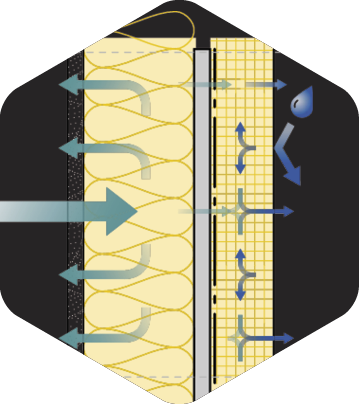
TimberBoard is a vapor open, high compression-resistant wood fiber board for residential and commercial continuous insulation applications. It feels familiar to work with while improving energy performance and long-term durability; unlike impermeable foam products that trap moisture, TimberBoard naturally absorbs, stores, and releases water vapor without losing its structural integrity, all while managing heat and thermal bridging — all year long.


At a Glance
PlayPlay
previous arrow
next arrow
At a Glance
Installation
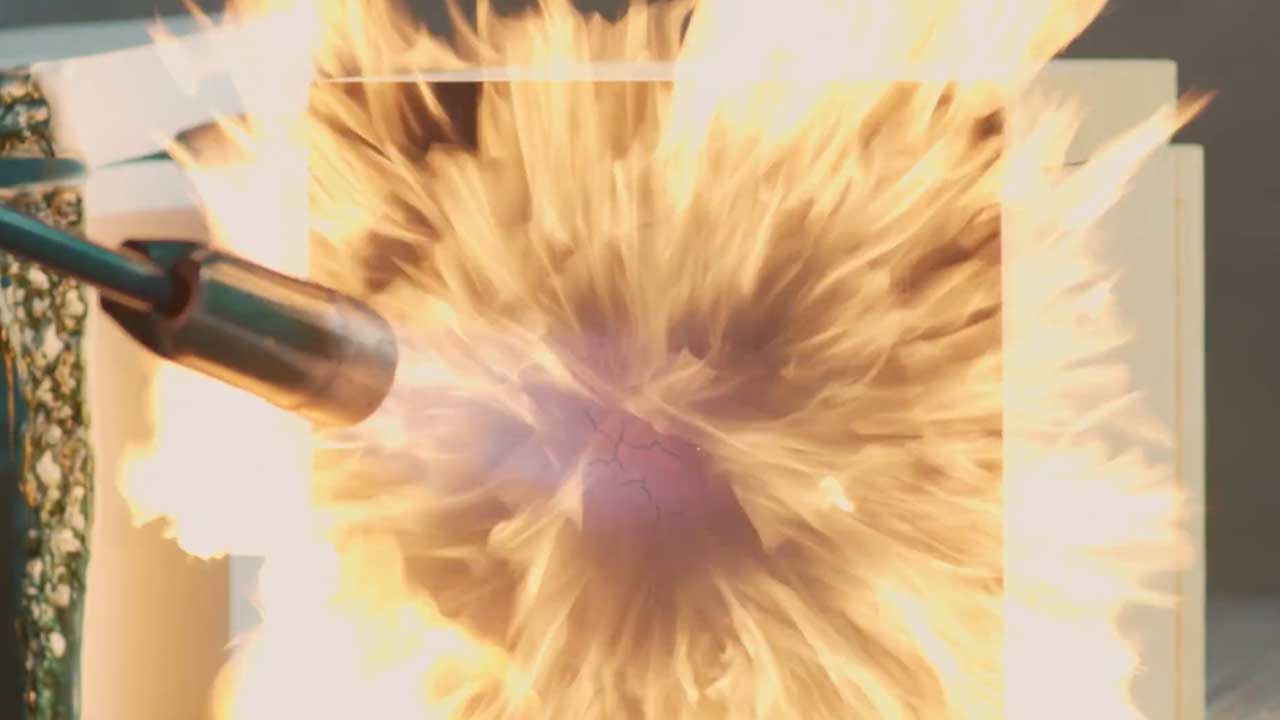
Fire Resistance
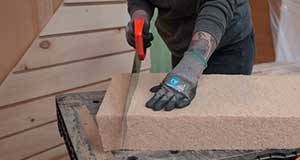
Cutting Tools
Saw Blades
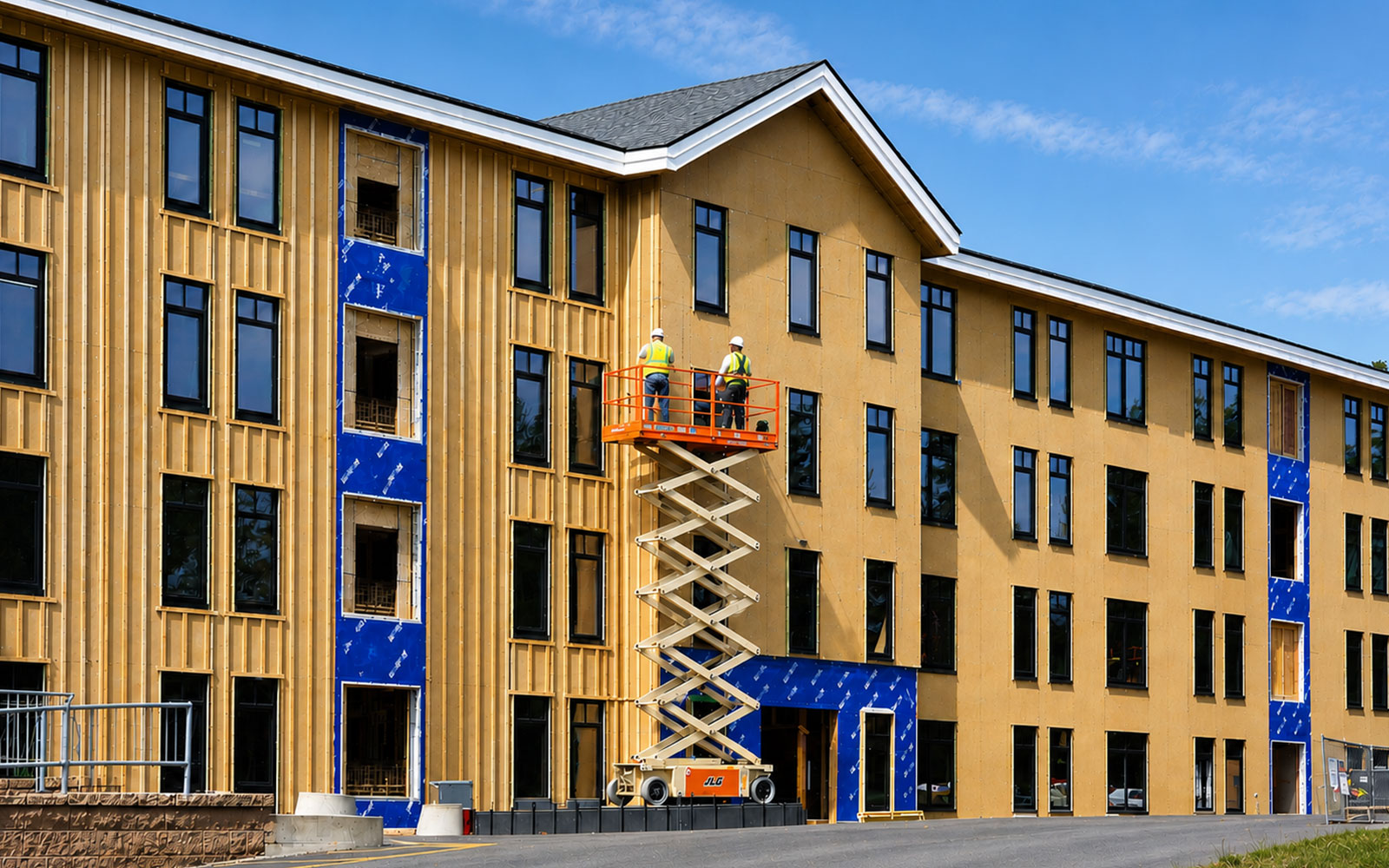
Installation
Installation
installation
previous arrow
next arrow

Durable Insulation for Residential & Light Commercial Projects

TimberBoard is a better way to insulate for builders and trade partners looking for an exterior continuous insulation that delivers advanced sound, thermal, moisture, and fire control without the comfort, performance, and jobsite trade-offs of conventional insulation solutions.

Key Benefits of TimberBoard Exterior Insulation

Superior Heat Delay: stores heat to slow summer heat gain and keep interiors cooler through the hottest hours

Code Ready CI: ICC-ES ESR-5387 evaluated for prescriptive continuous insulation in all climate zones

Built to Dry: vapor-open and water-resistant, with up to 6 months of weather exposure for scheduling flexibility*
High Compressive Strength: creates a flat, consistent strapping plane beneath cladding

Buildings That Give Back: made from residual softwood fiber, with low embodied carbon backed by a third-party verified EPD

Install Confidence: Made from wood fiber and installs with familiar tools and construction methods

Fire Performance: ASTM E84 Class B fire performance without added flame retardants

*Up to 6 months of exposure on sidewall applications during normal construction conditions. Follow TimberHP installation guidelines for best practices.

Continuous Exterior Insulation, Compared

Comparison of TimberBoard, Mineral Wool, and Foam Board insulation
CategoryTimberBoardMineral WoolFoam Board
Moisture Management Excellent Vapor Open Superior Drying Potential (Hygroscopic) Good Vapor Open Poor Limited Drying Potential
Heat Delay / Summer Comfort (learn more) Excellent High Heat Storage / Delays Summer Heat Good Moderate Heat Storage / Some Summer Heat Protection Poor Minimal Heat Storage / Does not protect from summer heat
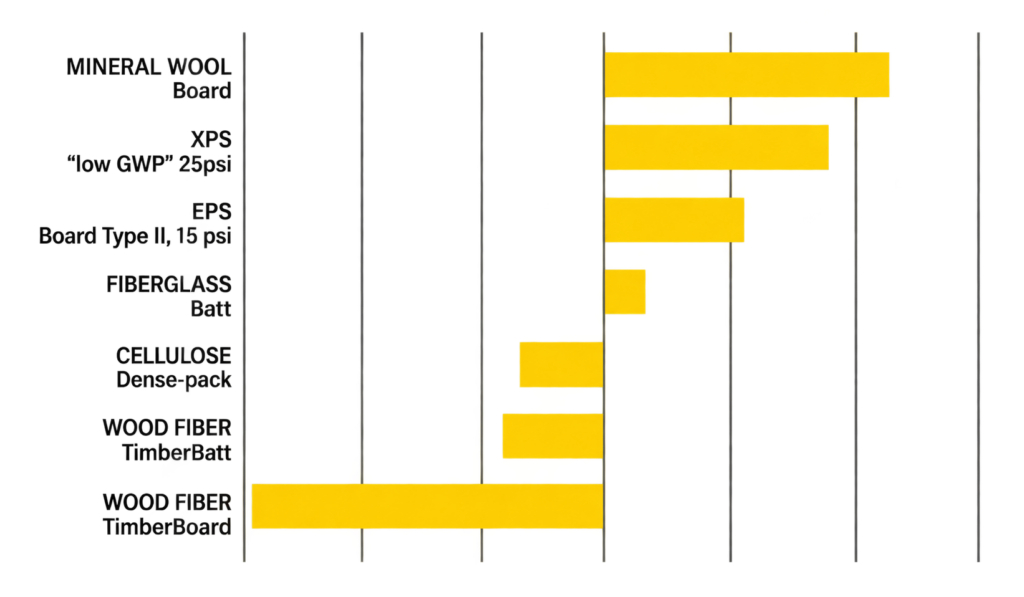
Carbon Footprint (CO₂e) Excellent 90%+ residual wood chips / Carbon Negative Good High Recycled Content / Moderate Embodied Carbon Poor Petrochemical-Based / High Embodied Carbon
Fire Resistance Good Naturally Fire Resistant, Chars Excellent Non-Combustible Poor Combustible Foam Releases Toxins When Burning
Ease of Install (Density) Excellent High Compressive Strength / Cuts with Standard Wood Tools Good Can Compress During Install Good Lightweight & High Compressive Strength
* Embodied Carbon (Default GWP) Kg CO₂e / 100 ft2 at R=1

TimberBoard Applications

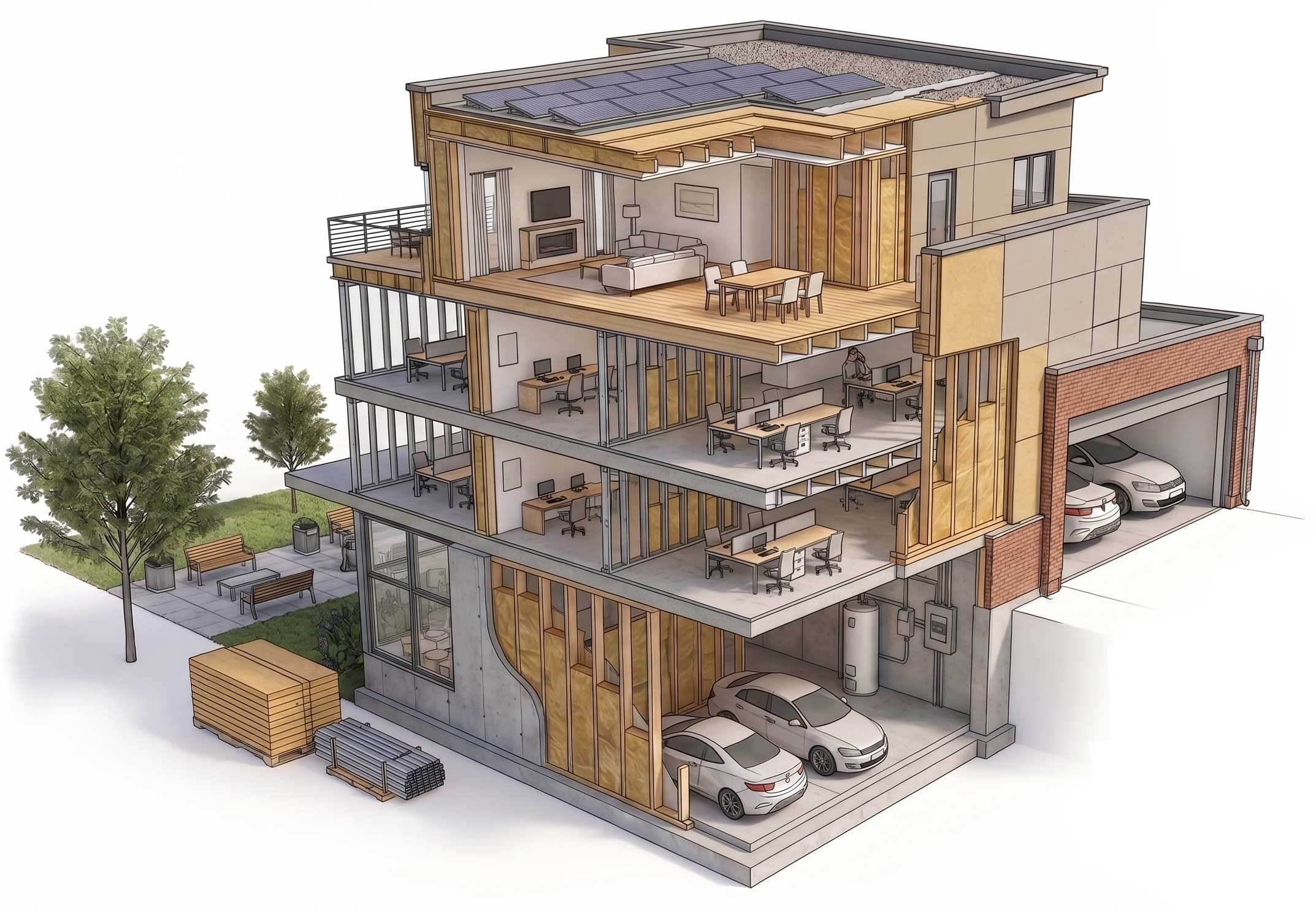
Click the blue pins to see how TimberBoard works throughout a structure. 

Continuous exterior insulation

As a continuous exterior insulation layer, TimberBoard reduces thermal bridging, boosts energy efficiency, and offers exceptional weather resistance—ideal for high-performance building envelopes.

Floors

Used beneath flooring systems, TimberBoard helps buffer temperature swings and dampen sound, while providing added structural resilience and a smoother surface for finished floors.

Outdoor storage

Outdoor storage under a roof or fully weatherproof cover (TimberHP bag covers, intact TimberHP plastic wrapping, or construction canopy) that prevents rain, snow, and direct solar exposure.
View Complete Guide

Project Highlights

TimberBoard Performance Attributes
Superior Heat Delay
Performance beyond R-value

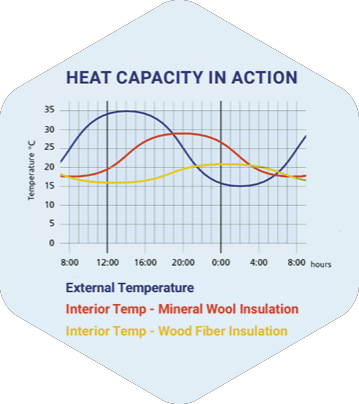
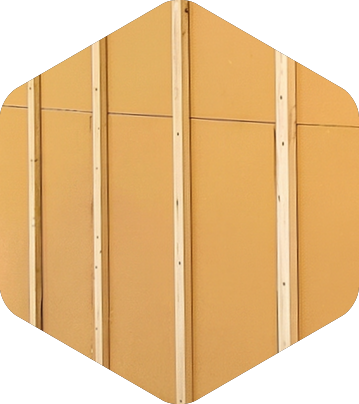
  • Two walls can have the same R-value yet feel dramatically different on a hot summer afternoon. Heat capacity and higher density (mass) help explain the difference
  • Heat capacity describes how much heat a material can absorb and store before its temperature rises. The more heat it can store, the longer it can delay that heat from moving through the assembly
  • Wood fiber has one of the highest heat capacities of any conventional insulation. In summer, it slows heat gain during the hottest hours of the day
  • Heat Delay works alongside R-value: R-value keeps heat in through steady winter cold, while heat capacity slows the daily summer heat peak

TimberBoard Product Line

Rigid Board Insulation - Square Edge
R 3.4-3.7/inch | Compressive strength > 10 PSI (70 kPa)

TimberBoard product specifications, pallet quantities, and configurations
Product LineThickness & ProfileSheet SizeWeight Per Piece (lbs)R-ValueQty. per PalletHeight W/O PalletWeight Per Pallet, Material Only (lbs)Configuration
Primary SKUs
TimberBoard1.5″ Square Edge48″ × 96″37.2R 530451116.01W30H
TimberBoard2″ Square Edge48″ × 96″49.6R 723461140.81W23H
TimberBoard2.5″ Square Edge48″ × 96″62.0R 918451116.01W18H
TimberBoard3″ Square Edge48″ × 96″74.4R 1015451116.01W15H
TimberBoard3.5″ Square Edge48″ × 96″86.8R 121345.51128.41W13H
TimberBoard4″ Square Edge48″ × 96″92.6R 1411441091.21W11H
Special Order
TimberBoarda5.5″ Square Edge48″ × 96″127.3R 208441091.21W8H
TimberBoarda7.25″ Square Edge48″ × 96″167.8R 26643.51078.81W6H
TimberBoarda9.25″ Square Edge48″ × 96″168.2R 34546.251147.01W5H

aproduct certification pending

How to Install Insulation in Exterior Walls

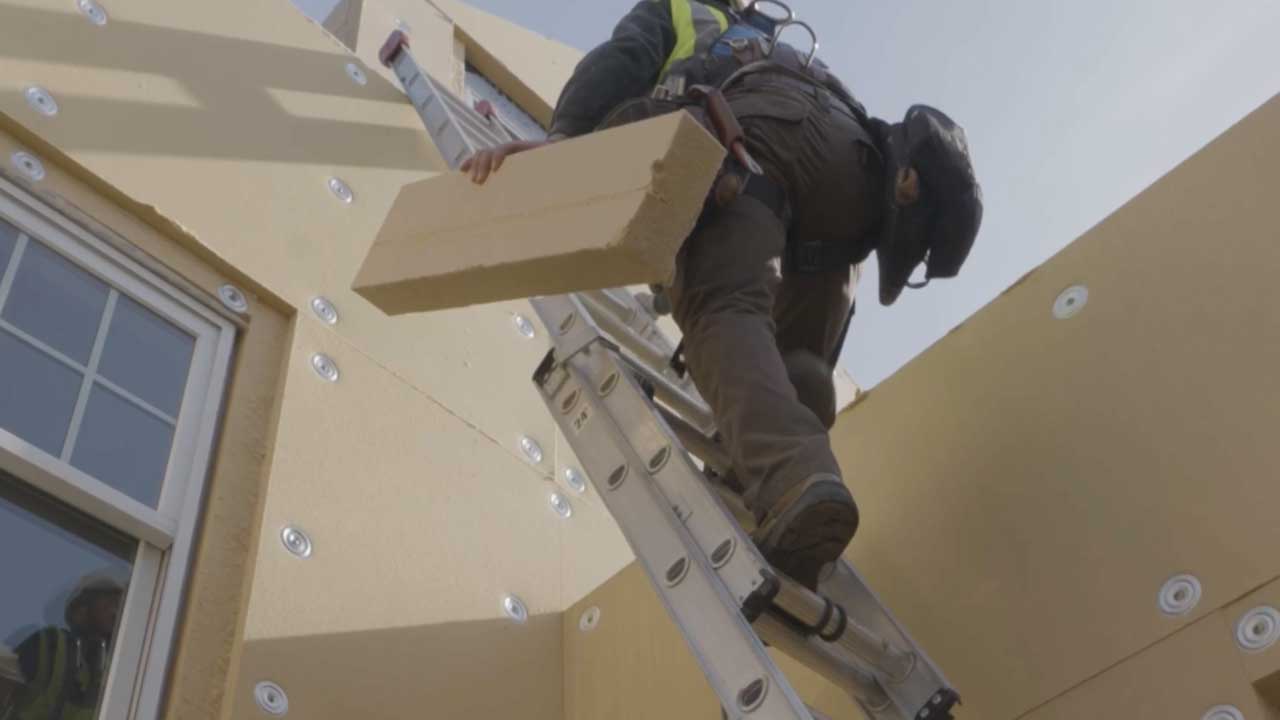
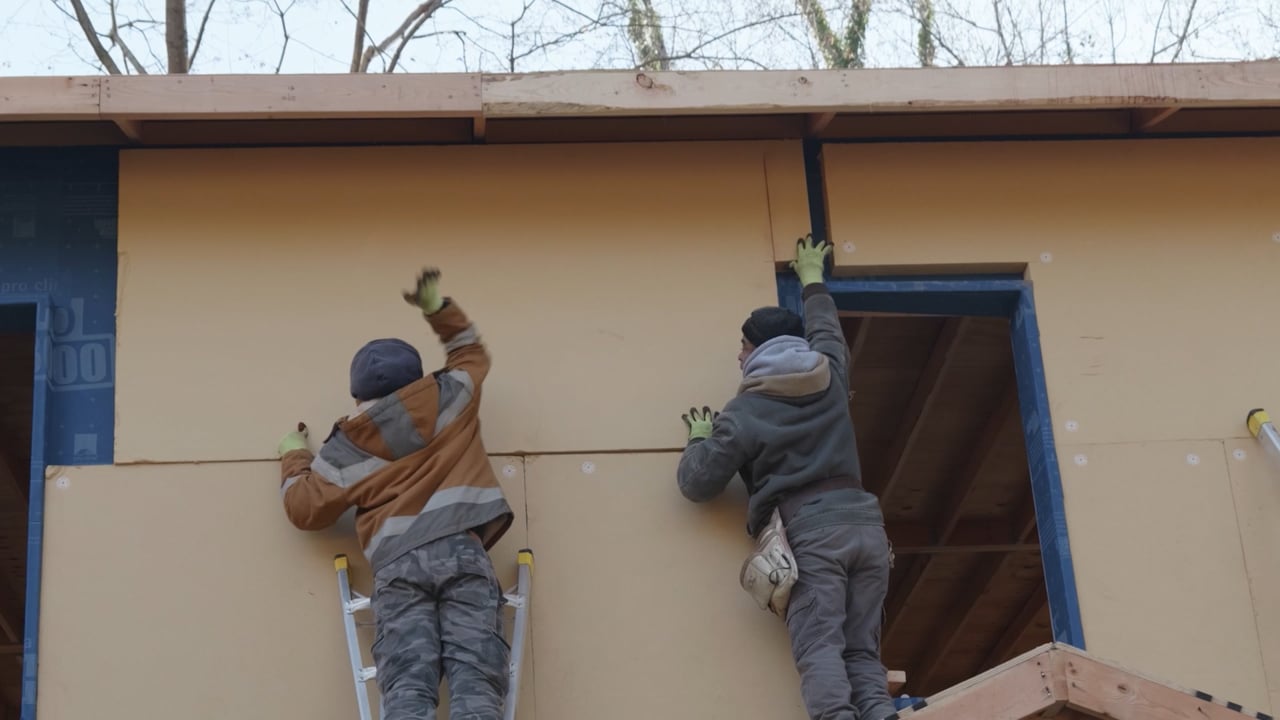
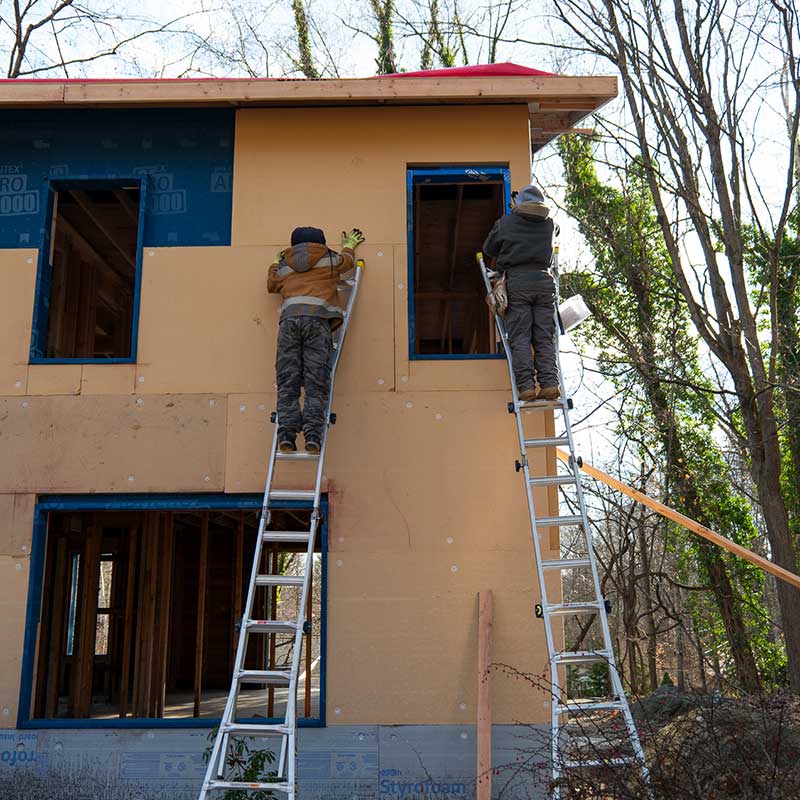
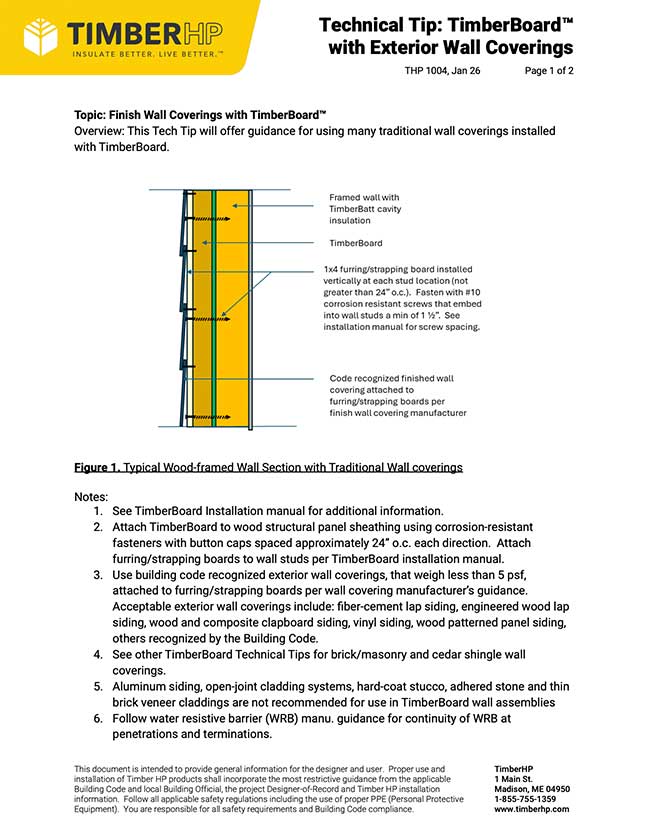
TimberBoard continuous exterior insulation is easy to install using standard tools and construction methods.TimberBoard can be utilized in a variety of wall assemblies and is typically installed on the exterior face of the wall sheathing. In most climate zones, it is recommended to install TimberBoard in conjunction with a vented cladding or rain screen assembly.

Install Videos

    Install Guides

    Frequently Asked Questions

    FAQs About TimberBoard and Continuous Exterior Wood Fiber Insulation:
    Q: What are the main differences between wood fiber, fiberboard, and insulation boards used in construction?

    A: Wood fiber insulation board is a type of rigid insulation made using compressed wood fibers and specifically engineered to deliver thermal management. Fiberboard and insulation board are broader categories that can include a variety of products with different compositions, densities, R-values, moisture management capabilities, and intended applications. 

    Unlike generic fiberboard and insulation board products, TimberBoard wood fiber insulation feels familiar to work with and helps improve energy performance without trapping moisture or compromising cladding attachment. Designed for rainscreen assemblies, TimberBoard is installed with familiar tools and construction methods while providing the durability needed beneath strapping and exterior cladding. Its vapor-open construction helps wall assemblies manage moisture, while its rigid structure provides a continuous thermal layer that reduces heat loss through framing and thermal bridging.

    A: Wood fiber board provides competitive R-value while offering thermal properties beyond R-value alone. TimberBoard delivers approximately R-3.4 - R-3.7 per inch, with available thicknesses providing approximately R-5 through R-34, depending on the configuration. However, While R-value measures resistance to heat flow, it doesn't tell the whole story.

    TimberBoard has one of the highest heat capacities of any conventional insulation available in North America, helping homes resist summer heat and reduce cooling demands during the hottest parts of the day.

    TimberBoard combines continuous insulation with thermal storage; wood fiber carries a high heat capacity to help buffer temperature swings and heat flow throughout the building envelope. TimberBoard also delivers vapor permeability and moisture management, making it a useful option for high-performance exterior wall assemblies where thermal efficiency can be achieved without relying exclusively on a higher R-value, closed-foam insulation.

    A: The best insulation for exterior walls depends on the climate, wall assembly, desired R-value, moisture management plan, fire regulations, sustainability goals, building codes, and installation requirements. 

    TimberBoard wood fiber continuous exterior insulation is a vapor open, renewable solution that is installed on the exterior side of wall sheathing. Its wood fiber construction creates a continuous thermal layer that reduces thermal bridging while allowing wall assemblies to manage and release moisture; TimberBoard delivers approximately 44 perms per inch of vapor permeability, 10-20 psi compressive strength, and ASTM E84 Class B flame and smoke spread performance, making it an ideal alternative to conventional exterior foam insulation.

    A: Wood fiber insulation typically provides competitive thermal performance and sustainability benefits due to its renewable, carbon-storing materials. TimberBoard’s rigid wood fiber construction provides thermal storage and helps reduce thermal bridging when used as a continuous exterior insulation, reducing temperature swings and making homes more efficient.

    TimberBoard is manufactured from residual softwood chips, reducing reliance on petroleum-based insulation materials. And because it is made with wood, it naturally stores carbon for the life of a project.  TimberBoard is also backed by a third-party verified EPD, and is one of the industry’s lowest-embodied-carbon continuous insulation materials.

    A: Wood fiber insulation, made from renewable softwood chips, uses natural materials to create high-performance buildings while supporting moisture management and healthier indoor environments. 

    Unlike impermeable foam products that can restrict drying, TimberBoard is vapor open, allowing assemblies to better manage and release moisture over time. Its permeable wood fiber structure helps buffer moisture while maintaining thermal performance, supporting more resilient wall assemblies and reducing the potential for condensation-related problems like mold and mildew.

    A: TimberBoard resists decay and insects when stored and installed as directed. To keep pests out, bug-screen mesh should be installed continuously at both the top and bottom of rainscreen cavities. Decay and insect issues are best handled by assembly solutions, not insulation solutions.

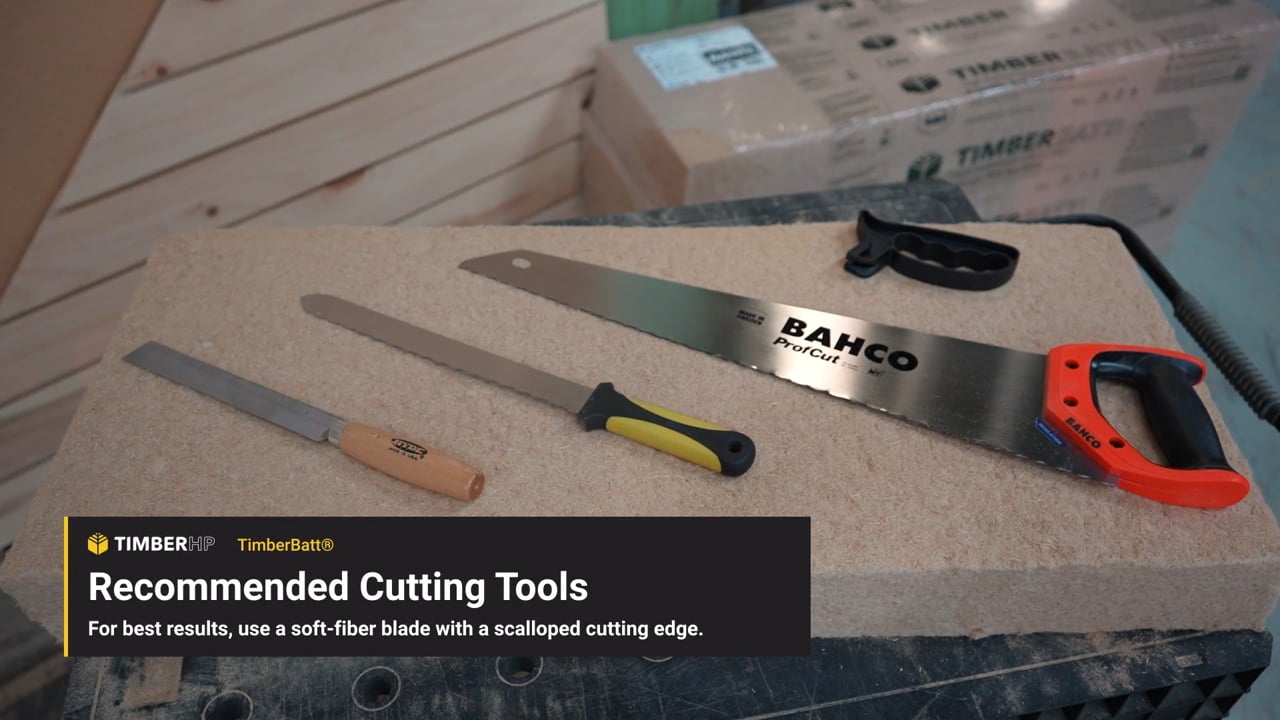
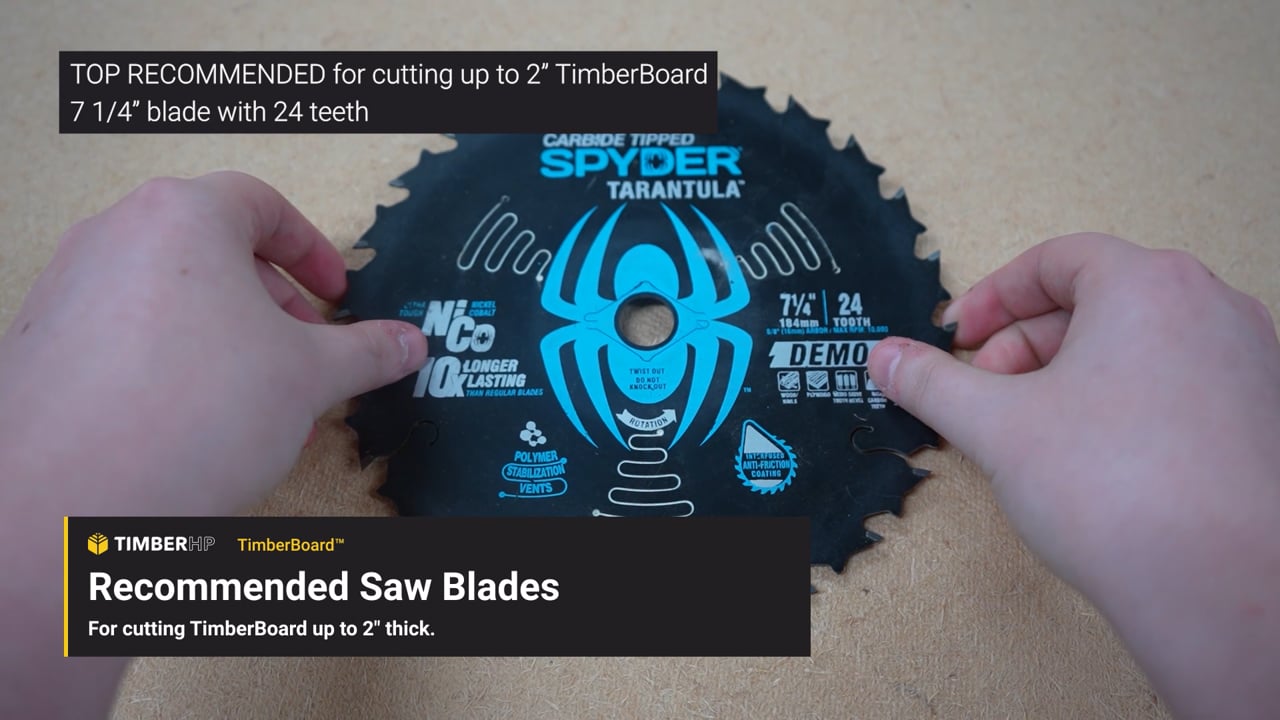
    A: TimberBoard can be cut using wood cutting jobsite tools, with the specific approach depending on board thickness. A General-purpose wood circular saw blade with 20 to 30 teeth is recommended for clean, efficient cuts.

    • 1.5″–2″ TimberBoard: Boards can be cut using standard circular saws (skill saws) & table saws. 
    • 2.5″–3.5″ TimberBoard: These thicknesses can still be cut using standard wood-cutting tools, such as circular saws or table saws. Dust extraction is recommended to help keep the blade clear and maintain cutting efficiency

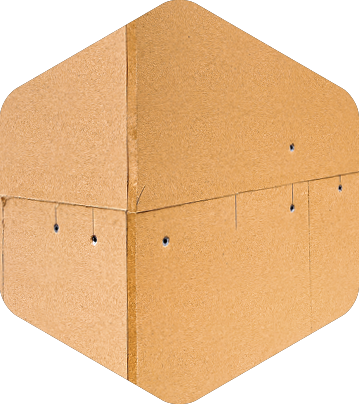
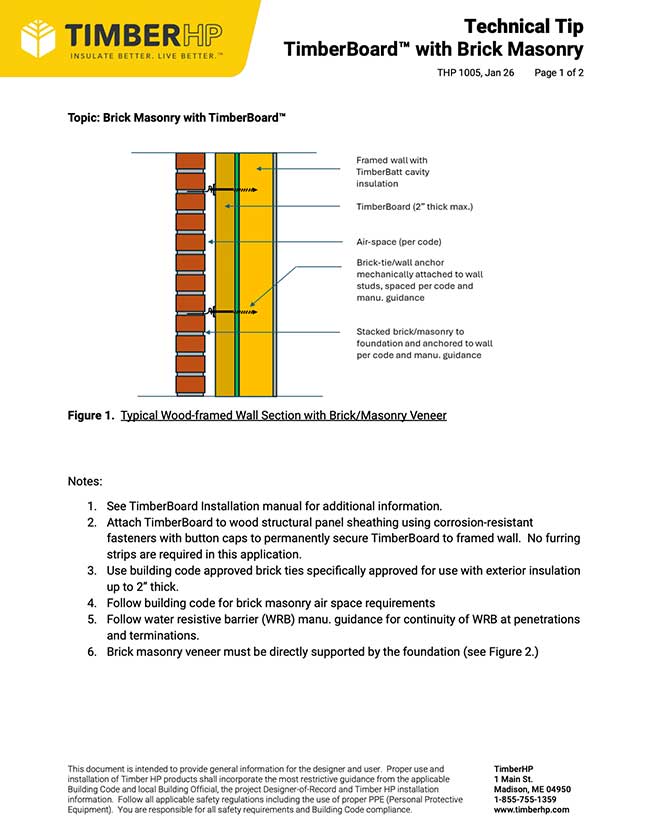
    A: TimberBoard may be attached directly to the wall structure using galvanized or stainless-steel nails or screws with button caps to initially hold the TimberBoard in place. The fasteners should be long enough to extend through the thickness of TimberBoard and past the inside face of the exterior wall sheathing by at least ¼”. Space the fasteners about 24 inches on center (all directions) to initially hold the TimberBoard in place. The attachment of strapping (or the attachment of direct-applied cladding) will permanently attach the TimberBoard in place. Please refer to our TimberBoard installation guide for more details.

    A: TimberBoard is Building Code recognized for use in applications above grade having no contact with the ground. Applications directly against the ground are not recommended.

    A: TimberBoard is currently Building Code recognized only for use as continuous insulation in framed walls. TimberBoard is in the process of obtaining code recognition for roof applications.

    A: The water resistive barrier (WRB) may be installed either on the interior or exterior side of the TimberBoard. Our installation information routinely indicates the WRB location against the wall sheathing. This location allows for straightforward flashing at penetrations and overall WRB continuity. WRB’s located on the outside of the TimberBoard require attention to details related to flashings and WRB continuity.