Wood fiber insulation plant TimberHP brings new jobs to Madison following mill takeover
Originally posted by Fox 22 of Bangor on February 16th, 2024 MADISON — Wood-fiber processing company TimberHP is bringing more than 100 jobs to the town of Madison. The business has set up shop at the site of the former Madison paper mill, which shuttered back in 2016. TimberHP creates eco-friendly insulation products using processed wood […]
Originally posted by Fox 22 of Bangor on February 16th, 2024
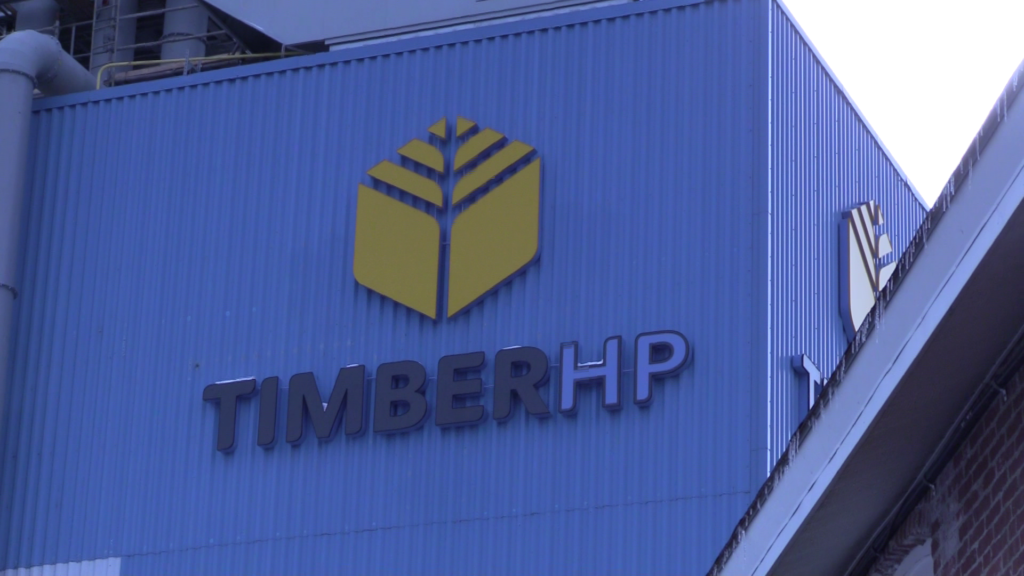
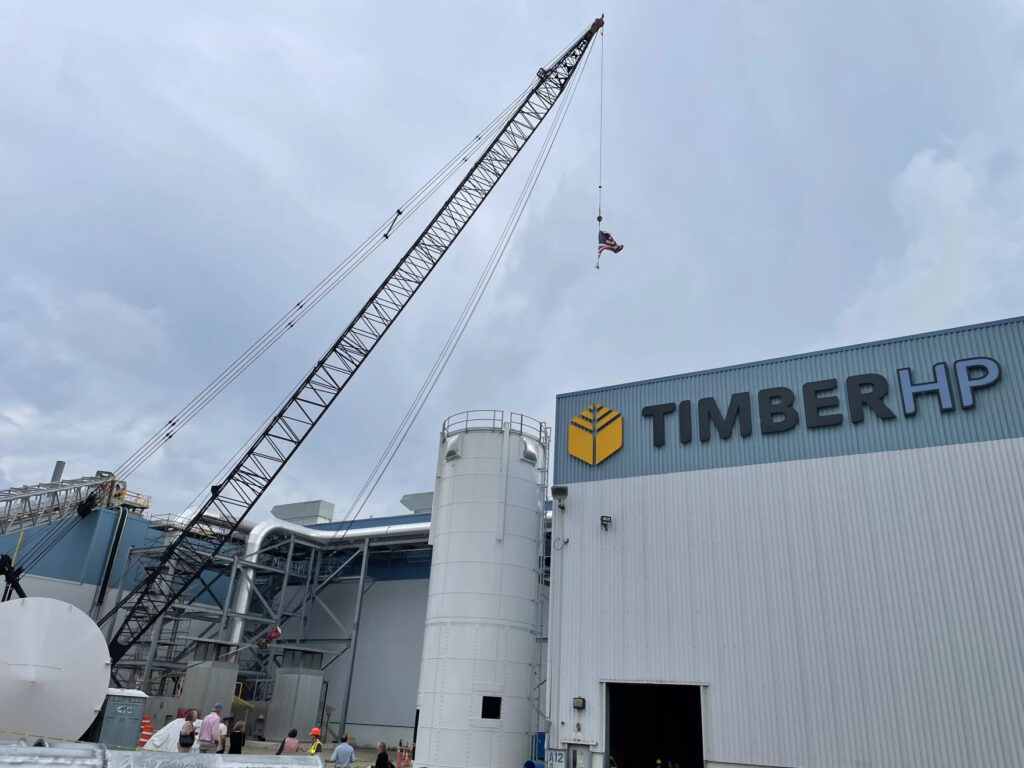
Exterior of TimberHP’s production facility in Madison, Maine
MADISON — Wood-fiber processing company TimberHP is bringing more than 100 jobs to the town of Madison.
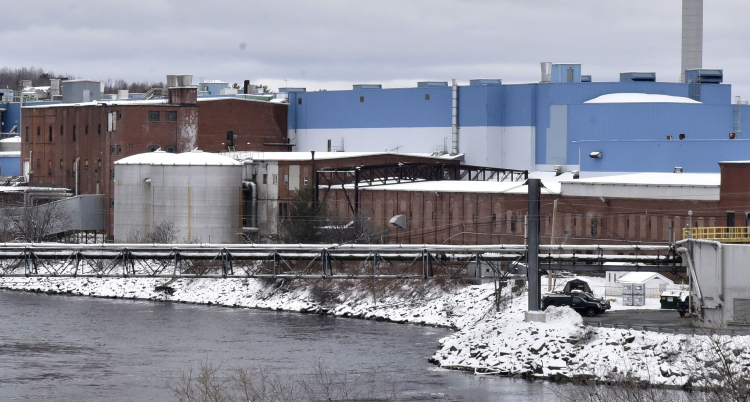
The business has set up shop at the site of the former Madison paper mill, which shuttered back in 2016.
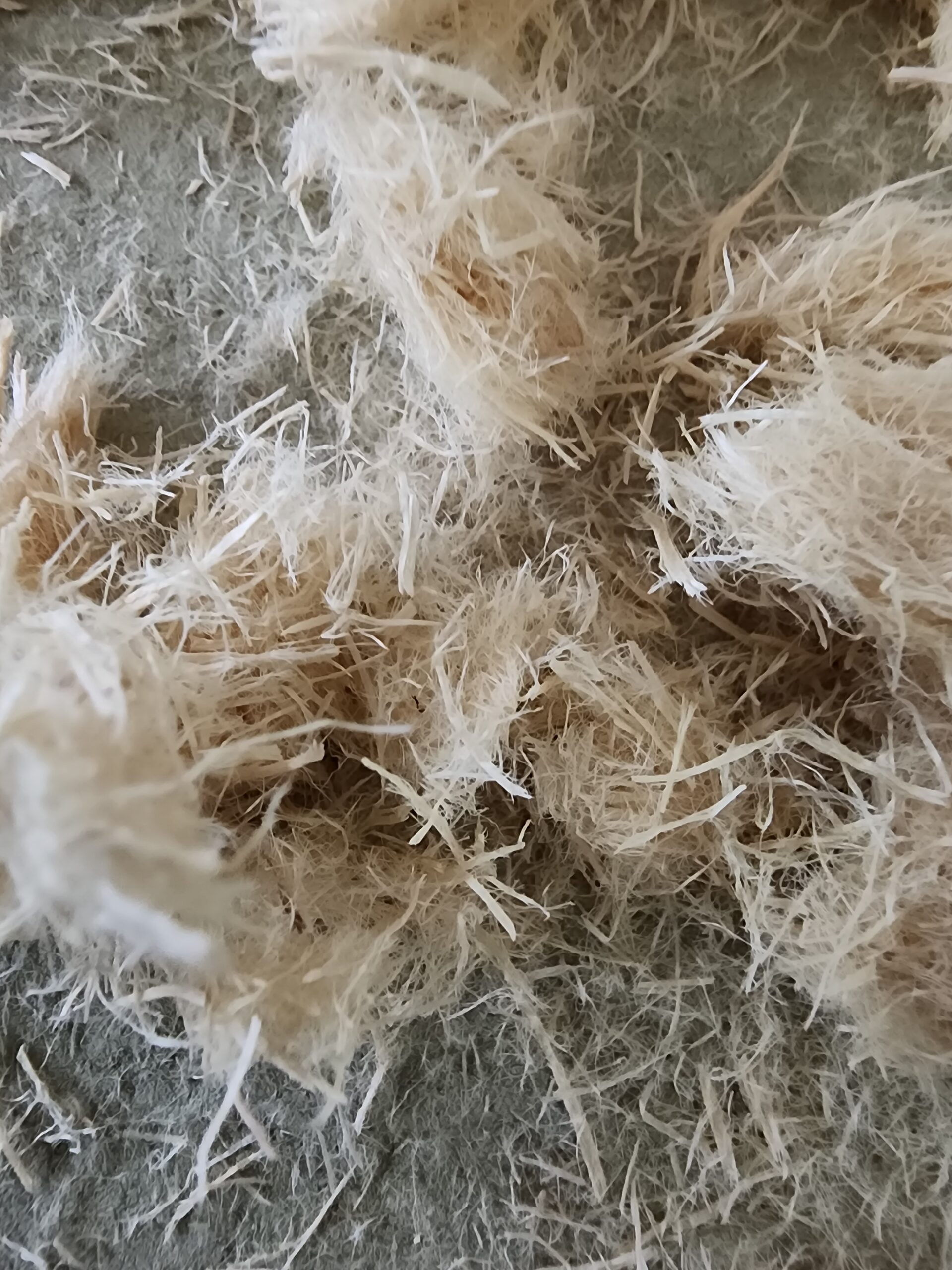
TimberHP creates eco-friendly insulation products using processed wood fiber, which doesn’t contain any fiberglass or other irritants found in most types of insulation.
The company is ramping up its operations as it gets ready to launch its full product line.
Town manager Denise Ducharme has lived in Madison for the last 40 years. She says when the paper mill closed down, there was a lot of uncertainty and concern for the town’s future. She says that all changed when TimberHP took over the facility.
“It was really hard. It was a difficult time for the community,” Ducharme said. “So it’s really exciting in that respect that we have this opportunity to see how TimberHP can fulfill the insulation needs and reduce carbon emissions and maintain a healthy planet. All the things they’re proposing to do and are currently doing.”
TimberHP still has dozens of positions to fill as they ramp up operations.
Building an Energy Efficient Home from the Ground Up: Choosing Sustainable Building Materials
So, you want to build a house? And not just any house, but one that considers home energy efficiency and long-term savings every step of the way. Embarking on the journey of constructing a home from the ground up is a remarkable milestone, often reflecting a culmination of experience, aspirations, and a readiness to invest […]
So, you want to build a house? And not just any house, but one that considers home energy efficiency and long-term savings every step of the way. Embarking on the journey of constructing a home from the ground up is a remarkable milestone, often reflecting a culmination of experience, aspirations, and a readiness to invest in a living space that truly reflects your personal journey. But where to begin?
We’re big proponents of highly energy efficient home designs but seeing as this isn’t yet standard practice for new construction (someday we hope it will be) we know that you as a homeowner will face a lot of choices along the way. This article is crafted to guide you through the myriad aspects of building an energy efficient home from the ground up, ensuring your investment is both personally, financially, and environmentally rewarding.
What Defines an Energy Efficient Home?
Before we get into the details of construction, let’s review what constitutes an energy efficient home. An energy efficient home is designed and built to reduce unnecessary energy consumption, greenhouse gas emissions, and demands on non-renewable resources. It achieves this through efficient insulation, windows, appliances, heating, and cooling systems, air sealing, as well as the use of renewable energy sources. The goal is to create a living space that is comfortable, sustainable, and cost-effective over its entire lifespan. Home energy efficiency exists on a spectrum, from existing construction with energy efficient upgrades to full passive house or net zero home design. Your home energy efficiency relies on several variables including:
Building materials
Appliances and electronics
Insulation and air sealing
Lighting
Heating and cooling systems
Water heating
Windows, doors, and skylights
Local climate
Energy source
Ventilation
And more
Homes can be rated using the national Home Energy Score system, with the average home falling around a five out of ten. When building an energy efficient home, you can decide what your efficiency goals are and the impact they will have on your home design and costs.
How to Build an Energy Efficient Home
As we discussed, there are many variables that feed into your home energy efficiency and good design will consider the interplay between all of them. You want a home that fuses functionality, aesthetics, and environmental responsibility. Taking a holistic approach involves considering every element – from the overall architectural layout to the smallest details like lighting fixtures. Even things we don’t typically think of when it comes to home construction are important, like how the home’s orientation impacts natural light and temperature regulation.
Even thoughtful landscaping can contribute significantly to home energy efficiency. Deciduous trees provide shade in the summer and allow sunlight in winter, natural windbreaks can reduce heating costs, and green roofs or walls can provide extra insulation.
Today’s homeowners and architects also have the benefit of some amazing smart home technology that can contribute to your home energy efficiency. Incorporating automated systems such as programmable thermostats, smart lighting, and energy-efficient appliances not only enhances the functionality of your home but also significantly reduces energy consumption. Appliances rated by Energy Star can reduce energy use by anywhere from 10-40% compared to other products and can have other benefits like reduced water use.
Working with an architect well versed in energy efficient new home construction will help guide you through all these decisions. Don’t be afraid to ask lots of questions along the way to best understand how everything in your energy efficient home design connects.
Choosing Sustainable Building Materials for Maximum Energy Efficiency
Every material that goes into your home represents both a cost to the environment and a potential savings to your energy use. Making careful selections of green building materials will ensure your home balances both.
Timber Framing: Compared to conventional stick-built homes, timber framing can reduce the amount of wood needed by up to 30%. Not only do they sink carbon, but they also provide naturally insulating properties for better thermal regulation. A timber frame supports the weight of the entire home, eliminating the need for load bearing walls in the interior and opening the design possibilities.
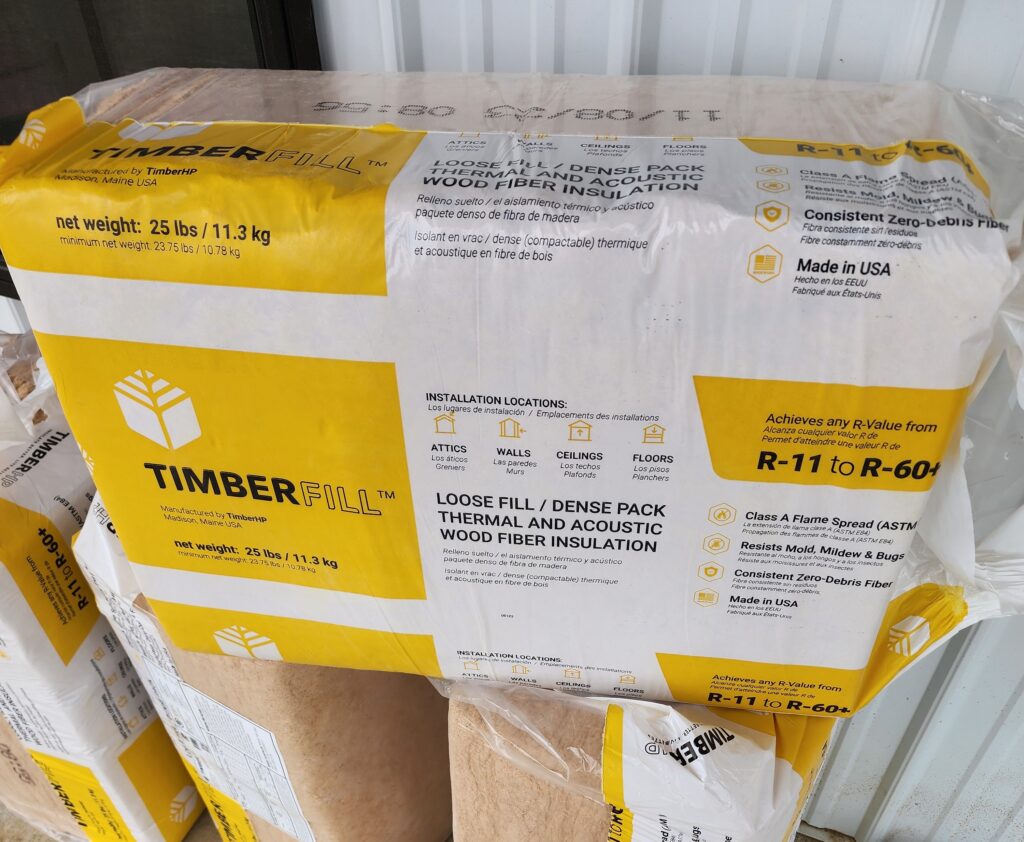
Wood Fiber Insulation: Made from a natural, renewable resource, wood fiber insulation is carbon negative, the only insulation of its kind. It offers a naturally high R-value that balances temperature swings and buffers changes in humidity to regulate your home’s climate in all seasons. This in turn means less energy (and money) needed to heat and cool your home. Wood fiber insulation can be used in floors, ceilings, and walls for a complete, energy efficient building envelope.
High-Performance Windows & Doors: Air sealing is incredibly important to home energy efficiency, so selecting high performance windows and doors can make a big impact. Look for high Energy Star ratings and characteristics like double or triple glazing when making your selections.
Cool Roofing: While climate is an important factor to consider when choosing your roofing material, most homes are built with dark, non-reflective materials that absorb heat. On sunny days, this can mean rooftop temperatures reaching 90-100 degrees above the air temperature. This of course, can quickly raise the need for air conditioning. Cool roofs use reflective materials to shed heat and keep your home cool with a potential for up to 25% savings on your energy bill.
Interior Sustainable Building Materials: When designing your home’s interiors, consider eco-friendly options like highly renewable bamboo flooring or reclaimed wood. While they may not have a huge impact on your long-term energy use, they do often use less energy to be manufactured, transported, and installed in your home.
While these high-performance materials may come with higher upfront costs, they are a wise investment for the long-term. The enhanced durability and superior energy efficiency they offer lead to significant savings in energy bills and maintenance costs over the years, making them a cost-effective choice for the full lifespan of your home. Builders of energy efficient homes can also claim up to $5,000 in tax credits for their work on energy efficient new home construction.
Installation & Maintenance
Selecting sustainable building materials is only half of the equation. Proper installation of these elements and maintenance of your energy efficient home are equally important to its performance. This means you will need to carefully vet your builders for experience working with these green building materials and technologies.
Energy-efficient materials often require less maintenance, but it’s important to understand the specific needs of the materials and technologies you choose to maintain their efficiency and longevity. Remember to change filters, clean ducts and schedule professional checkups for your heating, ventilation, and air conditioning (HVAC) system. If your home includes solar panels, they’ll need periodic cleaning and inspections to ensure they are functioning optimally. Debris, dirt, and even snow can impact their efficiency, so keeping them clean is essential. Likewise, the roof and gutters play a significant role in protecting your home from the elements. Keeping gutters clean and inspecting the roof for damage are important to prevent water infiltration, which can impact your home’s energy efficiency. Your water heater, energy efficient appliances and more will need similar regular maintenance.
Improving Home Energy Efficiency in the Future
Without a doubt, energy efficiency technologies for residential structures will continue to develop and improve with time. While your new energy efficient home is built for longevity, you can always consider making energy efficiency upgrades down the line. As of 2023, homeowners can receive up to $3,200 in rebates for qualifying improvements made to their home energy efficiency. The best thing you can do is take care of your residence and keep up to date on energy efficiency standards and new building technologies. You sign up for our email newsletter to receive regular updates about the latest in the high performance building industry as well as tips for maintaining your home.
Here’s to creating a more valuable, comfortable, and efficient built environment that is healthy for us and the planet!
This Maine-made wood insulation is starting to catch on
Originally posted by Bangor Daily News on February 7th, 2024 Wood fiber insulation, made for the first time in North America by Madison manufacturer TimberHP, promises to be the next big thing in Maine construction. The insulation is more sustainable than materials like foam. It is made using logging waste and sequesters carbon as well […]
Originally posted by Bangor Daily News on February 7th, 2024
Wood fiber insulation, made for the first time in North America by Madison manufacturer TimberHP, promises to be the next big thing in Maine construction.
The insulation is more sustainable than materials like foam. It is made using logging waste and sequesters carbon as well as cellulose insulation. Priced somewhere between mineral wool and fiberglass, it is a competitive option as construction costs continue to climb. Wood fiber also doesn’t trap moisture like plastic insulation does, which can rot a building out.
Production of TimberHP’s first product, a blown-in insulation, began last summer in Madison’s old paper mill. It is just starting to catch on. A 65-unit workforce housing development in Westbrook is using it. The College of the Atlantic in Bar Harbor has installed it in two buildings, and the company is trying to quickly expand its use in Maine.
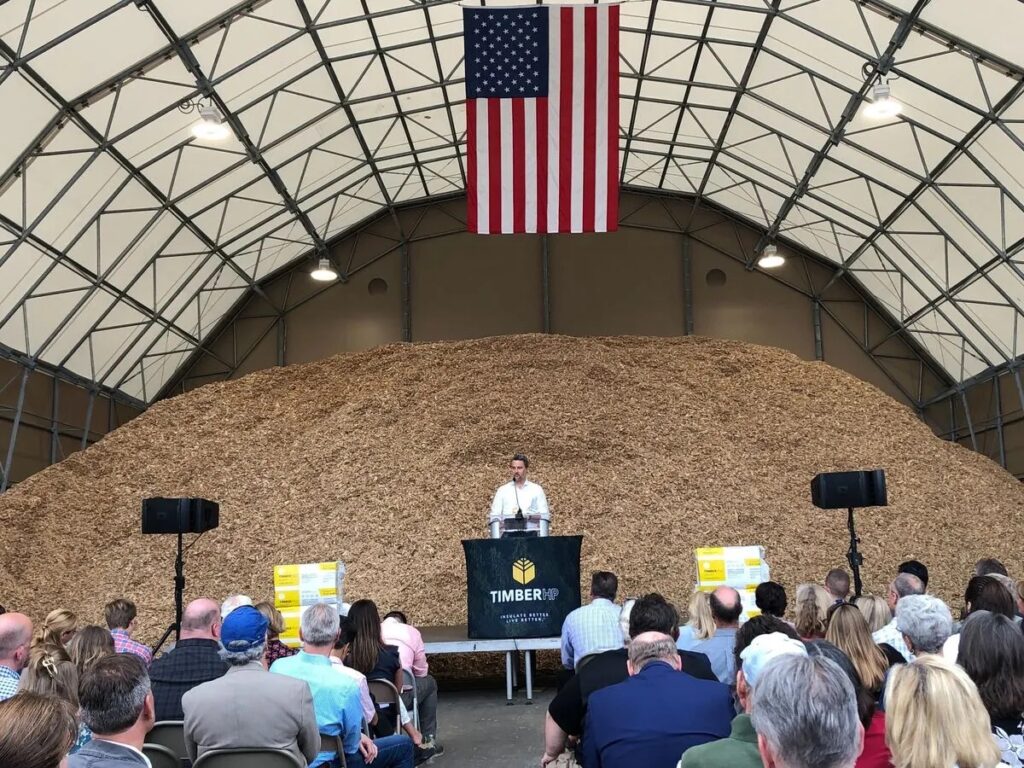
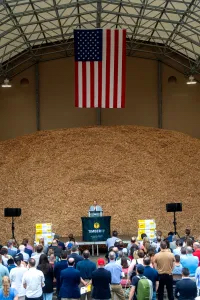
TimberHP cofounder Matt O’Malia speaks at an event on July 21, 2023, celebrating the company’s new wood fiber insulation mill in Madison. The mill is the first of its kind in North America. Credit: Billy Kobin / BDN
“As far as we’re concerned, it works better on every point. It was the same cost, it’s made in Maine, and it’s better for the environment, why wouldn’t we use it?” Jack Soley, the Portland developer who is using TimberHP’s blown-in insulation for the Westbrook development.
Avesta Housing, a Portland-based affordable housing developer, is considering using it for a couple of its projects in southern Maine, Matt O’Malia, TimberHP’s co-CEO, said.
Developers have been a little wary of using an insulation material that is practically untested here, O’Malia noted. It’s historically been viewed as a “premium sustainability product.” But the material has been popular in European construction for 20 years and is thought to have brought in $1 billion in revenue there last year, according to TimberHP.
In Maine, which is 90 percent forested, the product is cheaper to produce. Due to the shuttering of paper mills here in recent years, there is a great deal of logging waste no longer being used for pulpwood production. Cellulose, the most widely used sustainable insulation product, is made from such pulp.
“It’s a good transition from cellulose, as the market conditions have changed, to something that’s scalable going forward in the future, and can really be produced in volume.” O’Malia said.
Soley was originally going to use blown-in cellulose for his Westbrook project because of its sustainable properties, but the material would have had to be transported from “far away” to be used in Westbrook. That was an “environmental cost” Soley didn’t want to pay, he said.
TimberHP matched the price point of using cellulose insulation, Soley said. It also touted benefits like supporting Maine industry, higher heat efficiency and moisture wicking. His quote for installation costs also didn’t change once he switched to wood fiber, he said.
“It was a total no-brainer,” Soley said.
O’Malia said he sees his company’s staff of 75 eventually growing to 130 people, and the facility being open 24 hours a day and seven days a week.
The company is rolling out two more products this spring, one board and one batten-type insulation, that will diversify their offerings. To support that effort, the company was recently awarded $1 million in loans from the Finance Authority of Maine and the Maine Rural Development Authority.
At full production, the Madison plant will use around 250,000 green tons of wood annually. It’s not nearly the amount of input the facility once processed as a paper mill, but it’s still recycling refuse from logging that would otherwise have gone to waste and bringing some jobs back.
“There’s a great culture in Maine that knows how to do this kind of production and a really, really well-trained workforce,” O’Malia said. “We are definitely kind of able to plug into the legacy of that type of wood products manufacturing in Maine.”
Busting 4 Common Myths About Wood Fiber Insulation
The manufacturing of wood fiber insulation in the US only began in 2023, but the history of wood in construction is extensive. In many ways, this innovative building technology is very, very old. The first wood buildings were constructed more than 10,000 years ago in the Neolithic period. Even as Egyptian pyramids were built from […]
The manufacturing of wood fiber insulation in the US only began in 2023, but the history of wood in construction is extensive. In many ways, this innovative building technology is very, very old.
The first wood buildings were constructed more than 10,000 years ago in the Neolithic period. Even as Egyptian pyramids were built from stone and Roman temples were formed from marble, most residential buildings were made with wood. And while 92% of contemporary homes still use wood for framing, the development of new building technologies and improved manufactured materials in the 1900’s diversified the ingredients in our homes. Vinyl or brick made up exteriors, asphalt covered roofs, and fiberglass or spray foam insulation was popularized.
Now on the market for homeowners and building contractors in the US for the first time, wood fiber insulation is returning some ancient practices and benefits to residential construction. It’s no surprise that this innovation comes with some myths, so let’s discuss the four most common assumptions or misconceptions about wood fiber insulation.
1. Wood Fiber is More Flammable Than Other Types of Insulation
For all the millennia that wood has been a construction material, it has been a fuel source for thousands more. In fact, today wood is the main source of energy for more than 2 billion people, providing 14% of the world’s total energy. From fireplaces to wood stoves, we understand why there’s an association between wood and fire. Not to mention the fear of being subject to America’s more than 350,000 annual house fires.
But the truth is, we love this misconception. Because we love explaining how loose fill and batt wood fiber insulation get an ASTM E84 Class A Flame and Smoke Spread rating. After being steamed and refined, our wood fiber is blended with small amounts of Borate, a mineral that lends natural flame-retardant properties to the finished insulation. Meanwhile, our dense and durable wood fiber board earns a Class B fire rating without any added chemical flame retardants, outperforming foam board competitors.
These properties help prevent fire from spreading within your home, reduce the intensity of the heat and can allow walls to withstand flames for 1-2 hours. Don’t believe us? Check out how our TimberBoard performs in this flame test.
You can learn more about fire prevention and how wood fiber insulation contributes to the safety of residential and commercial buildings in this blog about National Fire Protection Agency testing.
2. Wood Fiber Insulation Will Absorb Moisture
If you’ve ever seen a fallen tree, soggy and rotten, laying in the woods while out on a hike—or worse, seen the crumbling porch of an old home—you know what moisture can do to wood, and it’s not pretty. When choosing between types of insulation, it’s understandable that you would want to avoid the need to replace rotten wood down the line.
We have good news for you: wood fiber insulation has the unique ability to allow moderate indoor humidity to pass through while resisting buildup of moisture. This is all thanks to its vapor open, breathable nature. So, when you shower or boil a pot of water for pasta, that moisture passes through your wood fiber insulation without reducing its R-value, preventing buildup that can lead to condensation and even mold.
Wood fiber boards are made with waxes and resins that make them hydrophobic, repelling bulk moisture so that your home stays dry in rain, snow, or other inclement weather. In fact, TimberBoard can be left exposed at construction sites for 3-6 months with compromising resilience.
Even better, when wood fiber insulation does get wet, it manages that moisture much like a living tree, spreading it evenly among fibers to maintain a consistent R-value. You can read more about this vapor open system or watch our water test below.
Wood Fiber Insulation Kills Trees
Globally, we lose around 5 million hectares of forest each year, which not only destroys habitats and diminishes priceless biodiversity but also releases carbon dioxide into the atmosphere, contributing to global warming. This is a serious threat to the future health of our planet and people, which is exactly why we set out to create a product that reduces and even reverses the acceleration of global warming.
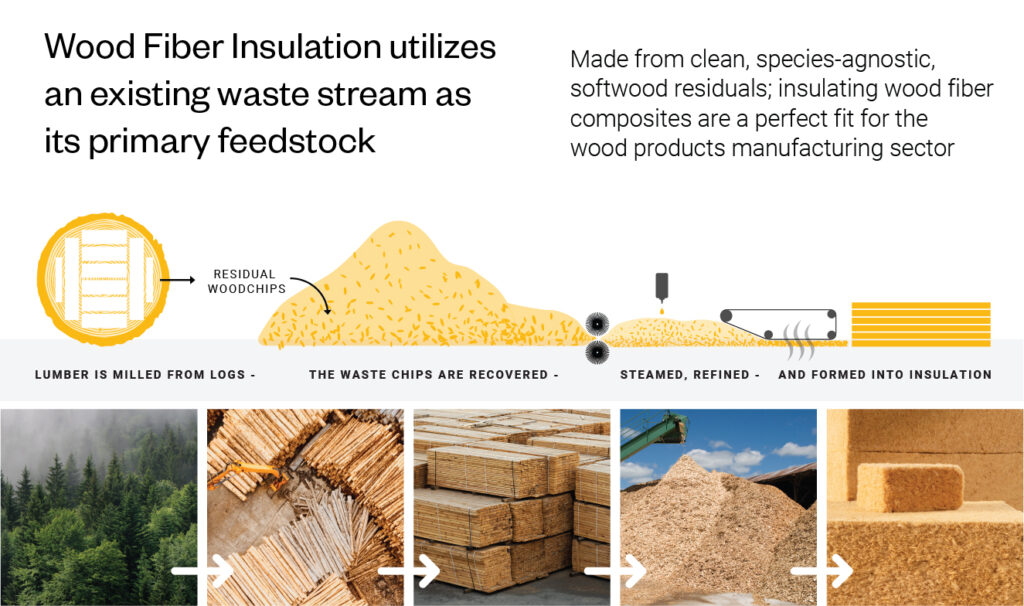
Our wood fiber insulation is made with leftover wood chips and wood waste from sustainable forest management and lumber production. We work with local lumber mills, sawmills, and forestry businesses to reroute their existing waste streams as our primary feedstock. Not only does this provide purpose to their residuals, but it also helps support their continued stewardship of Maine’s forests. In fact, Maine’s forest harvest rate is currently 30% below the replacement rate, with new trees sequestering additional carbon. This local system keeps our carbon footprint small, requiring minimal transportation compared to other products such as glass, sand, or chemicals for foam.
The finished wood insulation products themselves capture and store CO2 for the lifetime of the building. Unlike any other types of insulation, wood fiber products have a net negative carbon footprint of -9kg CO2 per 100 square feet. The answer to diminishing forests is not to ignore our timber resources, but rather to build systems that sustainably use and regrow them. Mass timber construction and products like wood fiber insulation are renewable, carbon-storing components of these systems.
Wood Fiber Insulation is More Expensive
Many of the same elements that make wood fiber insulation good for the environment also make it good for your wallet. Use of existing waste streams, minimal transportation, and even the conversion of an abandoned paper mill into our manufacturing facility contribute to our ability to price our wood fiber insulation competitively with conventional types of insulation like rock wool, fiberglass, and cellulose. We consider cost in every step of design and production. For example, wood fiber insulation uses a lower volume of Borate—the most expensive ingredient in our products—by weight than cellulose, keeping it more cost stable.
Our goal is to make wood insulation products mainstream and ultimately transform the building industry, which means ensuring our insulation is cost accessible to architects, contractors, and homeowners alike. In fact, we hope other manufacturers across the US take up the project of manufacturing wood fiber insulation, giving consumers more options and spreading this sustainable product to new markets.
We’re networking with new distributors every day, so check your area map for stockers near your and their local prices.
What Questions Do You Have About Wood Fiber Insulation?
We could talk about wood fiber insulation all day, so we welcome any questions or myths you still have about it. Need to know how to handle wood insulation on a jobsite? Or whether it can be used in your foundation? Want to get into the technical details of R-value for different types of insulation? Visit our wood fiber insulation FAQs to start digging in. We also host educational events, both in person and online where you can learn more about our products, sustainable building practices, and ask our team your burning questions. And of course, you can always send specific inquiries through our contact form.
Wood fiber insulation company TimberHP to expand production and staff in Maine
Originally posted by Maine Public on February 5th, 2024 TimberHP, the first company in North America to offer wood fiber insulation, is expanding production and staff. CEO Joshua Henry says the company will eventually hire more than 140 staff for full production. “And we think that’s really just the beginning, as people start to get […]
Originally posted by Maine Public on February 5th, 2024
TimberHP, the first company in North America to offer wood fiber insulation, is expanding production and staff.
CEO Joshua Henry says the company will eventually hire more than 140 staff for full production.
The headquarters of TimberHP, located at the old paper mill in Madison. TimberHP is the first company in North America to offer wood fiber insulation.
“And we think that’s really just the beginning, as people start to get their hands on the material and recognize it’s performance attributes,” he said.
The company, which operates at the former Madison paper mill, has been producing a loose fill insulation for several months, and just began shipping TimberBatt, a denser insulation this week. The third and final product, an insulation board will begin production in the coming months.
The Finance Authority of Maine and the Maine Rural Development Authority has approved a million dollars in loans for the expansion.
Henry says the support from buyers and retailers has been gratifying.
“To have that kind of support from people who have been in the industry for so long, it feels, its amazing,” he said. “And really we’re just working every day to really justify their belief in us and their investment in these products.”
Advocates of wood fiber insulation say it is more sustainable than traditional materials. Last month an apartment complex in Westbrook became the first multi-unit building to use TimberHP insulation.
Madison-based TimberHP aims to be fully open this year as more public financing arrives
Originally published by Central Maine January 30th, 2024 The $500,000 in financing recently approved by the Finance Authority of Maine is expected to help create and retain more than 100 jobs in Somerset County by allowing the manufacturer to buy equipment needed for its full product line, the agency said. MADISON — The latest state […]
Originally published by Central Maine January 30th, 2024
The $500,000 in financing recently approved by the Finance Authority of Maine is expected to help create and retain more than 100 jobs in Somerset County by allowing the manufacturer to buy equipment needed for its full product line, the agency said.
The former Madison Paper Industries mill on Main St. in Madison, now home to TimberHP, a division of Belfast-based GO Lab Inc., which uses renewable resources to produce wood fiber insulation products. Morning Sentinel file
MADISON — The latest state financing awarded to local manufacturer TimberHP is expected to be the one of the last pieces needed to bring the company’s promise of more than 100 jobs to the region.
The $500,000 in financing approved by the quasi-independent Finance Authority of Maine is expected to help create and retain more than 100 jobs in Somerset County by allowing the manufacturer to buy equipment needed to produce its full product line later this year, the agency said in a statement.
TimberHP, a division of Belfast-based GO Lab Inc., uses renewable resources to produce wood fiber insulation products, according to the company’s website. The products are the first of their kind in North America.
The company began operations last year in Madison at the former Madison Paper Industries mill on Main St., which closed in 2016. The renovation of the mill, funded largely through public-private partnerships, cost about $150 million.
The company now employs 75 people, a company spokesperson said Monday. When production facilities are completed, which is expected later this year, the manufacturer plans to employ 114 people in Madison.
“We are pleased to provide additional support for GO Lab’s project in Madison,” FAME CEO Carlos Mello said in a statement. “Finding new uses for wood fiber, including innovative building materials, has the potential of revitalizing the forest products industry in Maine, which we fully support.”
The latest financing adds to a growing investment of millions from several quasi-public funding agencies, according to the FAME statement.
FAME previously approved up to $85 million in conduit bond financing, a type of public-private partnership that raises funds for private entities through bonds, according to the agency. The Maine Venture Fund, originally created by the Maine Legislature in 1995, also invested $3.5 million in 2023.
That is in addition to several loans approved in recent years, including a separate $1.2 million from FAME and other lending partners; $1 million from the Maine Rural Development Authority; $400,000 from the town of Madison; $300,000 from the Somerset Economic Development Corp.; and $250,000 from the Eastern Main Development Corp.
FAME has also awarded $860,000 in state tax credits through its Seed Capital Tax Credit Program, according to the agency.
“Financing we have received from FAME, the Maine Rural Development Authority and other economic development entities across the state have been instrumental in getting us to the finish line on schedule,” Joshua Henry, president and CEO of GO Lab Inc., said in a statement.
The manufacturer, seen by many officials as an example of how to revitalize former mill towns, has drawn attention from Maine’s congressional delegation and Gov. Janet Mills, who attended a ribbon-cutting ceremony July 21 at the Timber HP site.
“This extraordinary milestone is an example of how public-private collaboration can create good-paying jobs, advance our clean energy goals and bring new life to our old mills,” Mills said at last year’s grand opening ceremony.
Westbrook residential development is nation’s first to use TimberHP’s insulation
Originally published by Mainebiz January 29th, 2024 A multi-income residential development in downtown Westbrook will be the first residential project in the nation to use TimberHP wood fiber insulation, according to a news release. In 2021, College of the Atlantic’s Davis Center for Human Ecology, in Bar Harbor, was the first project overall to use […]
Originally published by Mainebiz January 29th, 2024
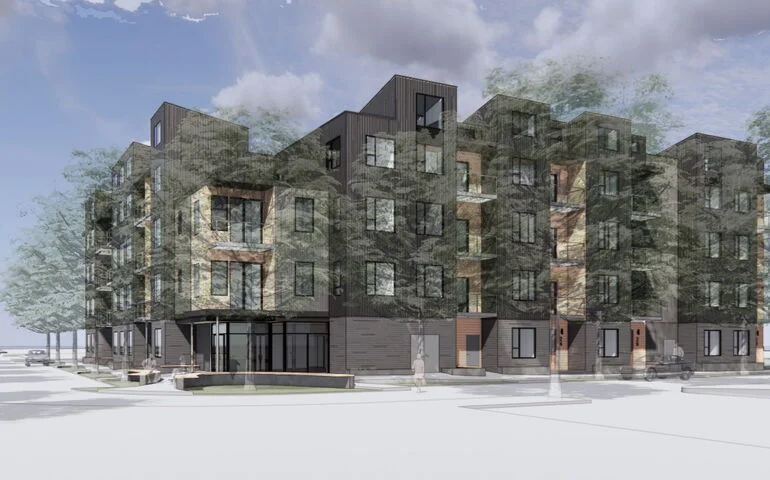
Courtesy New Ventures The Seavey Terraces apartment complex in downtown Westbrook broke ground in October and is reportedly the first such project to use TimberHP wood fiber insulation.
A multi-income residential development in downtown Westbrook will be the first residential project in the nation to use TimberHP wood fiber insulation, according to a news release.
The first phase of the Westbrook project, the Seavey Terraces apartment complex, broke ground in October and will provide 65 units to serve as workforce housing at below-market rates. In all, the development will eventually add 168 new housing options to the area, with a mix of affordable, workforce and market-rate homes.
The development is a project of New Ventures, led by Portland developer Jack Soley and builder Tim Hebert of Hebert Construction in Lewiston.
Working with Simons Architects in Portland and New York City-based engineering firm Thorton Tomasetti, the three-phase development includes TimberHP’s wood fiber insulation.
TimberHP, led by Joshua Henry and Matthew O’Malia and operating in a retrofitted mill in Madison, makes high-performance wood fiber insulation for homes and other buildings. Conceived in 2015, the startup is the first U.S. company to make the product.
The insulation is made from wood chips left over from lumber production.
“By embracing TimberHP’s TimberFill, we’re not just constructing homes; we’re pioneering a movement towards more energy-efficient and healthier living environments,” said Soley.
Soley said conventional insulation can cause problems with occupant health and long-term building resilience, by adding unwanted chemicals that can off-gas and by trapping moisture that can result in mold and rot.
TimberHP’s insulation is nearly all wood and manages moisture better than other products on the market, according to the release. Borate salt, added to softwood fiber to guard against fire and serve as a wood preservative, is the only additive to the company’s blow-in insulation.
“This insulation not only enhances energy efficiency but also prioritizes the well-being of our residents and the environment,” said Hebert. “In addition, TimberFill exceeded the R-value that was originally specified with cellulose and came in at the same price point.”
Combining Types of Insulation: Can You Install Wood Fiber Over Existing Insulation?
The market for different types of insulation materials is evolving at a rapid pace, driven by a growing awareness of the need for energy efficiency, improved indoor air quality, comfort, and sustainability. Yet these advancements don’t discount that many homes already have insulation like fiberglass, cellulose, or spray foam. Replacing insulation isn’t a task for […]
The market for different types of insulation materials is evolving at a rapid pace, driven by a growing awareness of the need for energy efficiency, improved indoor air quality, comfort, and sustainability. Yet these advancements don’t discount that many homes already have insulation like fiberglass, cellulose, or spray foam. Replacing insulation isn’t a task for the faint of heart—professional services can be pricey, removing old insulation can sometimes pose health risks, and accessing certain spaces can require drywall to be taken down. As a homeowner, how do you balance a desire for higher efficiency, comfort, and sustainability with the reality that you already have insulation in place? The answer may be in an unexpected marriage of old and new.
In this article, we’ll talk about how your old insulation might fall short, the logistics and compatibility of adding insulation over existing, and the benefits of integrating innovative types of insulation like wood fiber into your home.
Existing Types of Insulation (And Their Imperfections)
While there are many types of insulation, a 2018 survey found that 71% of new homes built used blow in fiberglass or fiberglass batt insulation. There’s no great source of data documenting the types of insulation in older homes, but fiberglass has been around since the 30’s, cellulose was popularized in the 50’s and spray foam emerged in the 80’s so it’s safe to assume that plenty of today’s homes include these types of insulation. As for even older homes… well, they may not have insulation at all!
Meanwhile, renewable, high efficiency wood fiber insulation didn’t begin to penetrate the European market until the 90’s and is only now being manufactured in the US for the first time in Madison, Maine. Of course, we’re proud to see zero-carbon and Passivhaus design standards making headway for new construction, but we also believe the most sustainable home is often the one that’s already built. One of the best ways to improve an existing home’s energy efficiency is through proper insulation.
Fiberglass, spray foam and cellulose all have their unique benefits but they each also have key flaws when it comes to long term energy efficiency and home health. For example, spray foam insulation can off-gas dangerous chemicals even a year or more after application, posing health risks to the environment and your family. Likewise, fiberglass requires protective gear during installation or removal, and any exposed insulation can lead to tiny glass particles in the air, an irritant to both skin and lungs.
Both fiberglass and cellulose insulation can settle over time, and when not properly installed can create air pockets, decreasing their R-value. All types of insulation can suffer from cases of poor installation, like uneven distribution in attics and crawl spaces, poorly cut batts, or incorrect quantities of insulation which can be more common in older homes. And many traditional types of insulation rely on fossil fuels, or struggle with the renewability of their feedstock. So, what is a homeowner with these types of insulation to do?
Can You Put New Insulation Over Old?
The short answer is, yes. Chances are, if your existing structure—rafters, wall studs, etc.—are free of rot and other structural issues, you are in a good position to add insulation. This process of adding insulation where there was none or in addition to existing insulation is often called re-insulation or retrofit insulation.
In an ideal world, insulation could magically materialize behind sealed drywall surfaces and the whole re-insulation process would be done with the snap of your fingers. Instead, fully replacing insulation would require carefully removing wallboard, pulling out screws and nails, inserting new insulation, and then meticulously reinstalling and finishing the drywall with a fresh coat of paint. It’s messy, time-consuming, and typically not a cost-effective retrofit. So, the real question is not can you put new insulation over old, but can you do so without tearing out walls and other parts of your home?
Blown in Retrofit Insulation
The easiest way to boost your home’s energy efficiency when the performance of existing insulation falls short is to choose a blown in insulation like loose fill wood fiber insulation. They are perfect for achieving even coverage in open areas like attics and or can be installed as dense pack in crawl spaces only requiring small, reparable holes to be drilled to fill wall cavities. You will still need a professional to operate the blower, reach the ideal insulation depth, and make small drywall repairs but this retrofit insulation method is far less disruptive to your home. With proper air sealing, you can even add wood fiber blown in insulation over batts to eliminate air pockets.
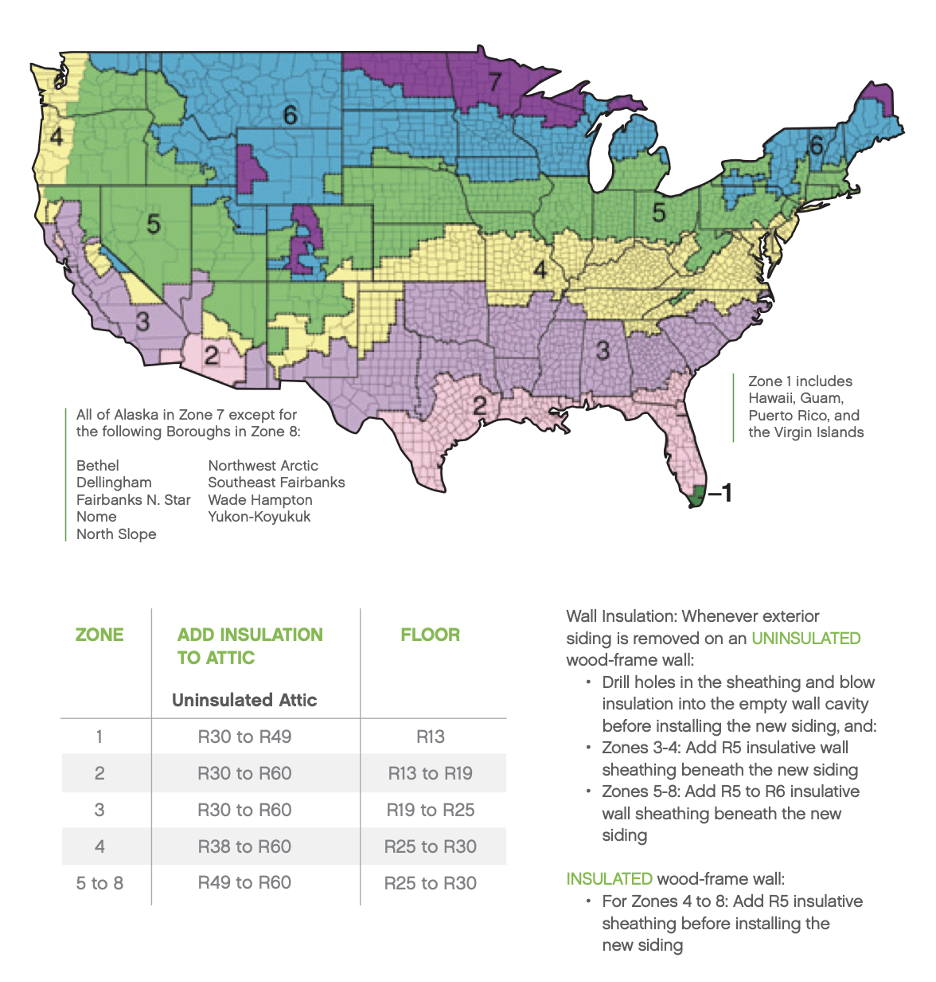
Re-insulation can significantly improve the overall R-value of your home’s envelope, reducing the cost of heating or cooling your home, improving your indoor air quality, making your space more comfortable, and adding value to your property. Start the retrofit insulation process by determining your insulation’s current R-value and using the chart below to determine the recommended R-value for your region. Then refer to our loose fill wood fiber insulation spec sheet to determine the quantity of insulation you will need add to specific areas of your home to achieve your recommended R-value.
Replacing Insulation for the Long Term
For homeowners looking to take their insulation upgrade to the next level, fully replacing insulation with wood fiber offers a comprehensive solution that elevates energy efficiency and sustainability to new heights. While retrofit insulation is an easy and cost-effective approach, opting for a complete replacement provides several distinct advantages.
First and foremost, replacing insulation allows for a fresh start, unencumbered by the limitations of existing insulation. By safely removing old insulation, you eliminate any potential issues it may have, whether it’s compromised by moisture, harboring dust, and allergens, or simply not performing at its best. It can also reveal underlying issues that may impact your home’s energy efficiency, like air leaks, gaps, or inconsistencies in the insulation barrier. Draft proofing and other repairs at this stage ensure any new insulation you apply can do its job and is essential for achieving an optimal thermal envelope.
Removing old insulation also opens your toolbox beyond blown-in insulation. Wood fiber insulation is available in flexible batts, boards, and loose fill, all safe for anyone to install, with superior R-value, fire resistance, moisture management and a carbon negative footprint. The result of fully replacing insulation with wood fiber is a home that not only boasts remarkable energy efficiency but also aligns with your commitment to sustainability. It’s an investment in long-term benefits, both for your family and the environment.
Finding a Balance that Works for Your Home
We understand the emotional and financial considerations that often accompany any remodeling project. Any home renovation comes with some disturbance to your safe space and taps into your budget. Luckily, when it comes to enhancing your home’s energy efficiency, there are re-insulation options for every budget and project size. Whether you’re looking for a quick insulation upgrade or thinking about removing old insulation for a clean slate, the TimberHP team is here to provide expert advice and innovative insulation products to help you get the job done.
How is Wood Fiber Insulation Made to be Rot & Fire Resistant?
By Randy Williams Recently, I was invited to a BS and Beer meeting (BS stands for Building Science) at a home under construction near Kansas City, MO. The meeting featured an installation demonstration of TimberHP’s TimberFill wood fiber insulation. This new loose-fill wood fiber insulation was being blown into the attic and dense packed into […]
By Randy Williams
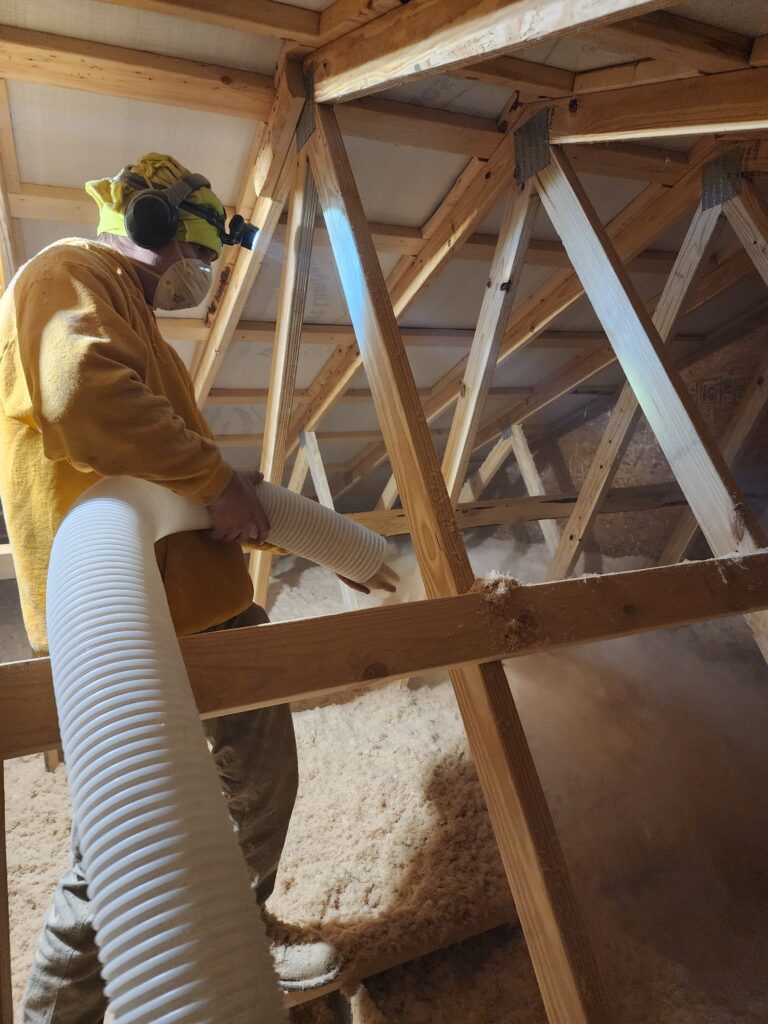
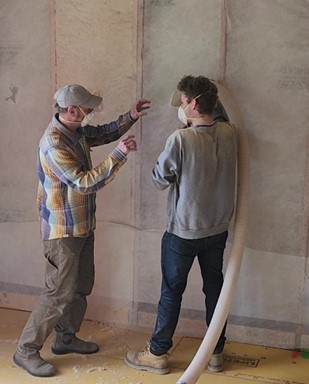
Recently, I was invited to a BS and Beer meeting (BS stands for Building Science) at a home under construction near Kansas City, MO. The meeting featured an installation demonstration of TimberHP’s TimberFill wood fiber insulation. This new loose-fill wood fiber insulation was being blown into the attic and dense packed into the walls. Two representatives from TimberHP, Business Development Manager Dan Edelman and Field Education Specialist Matt Damon were on hand to answer any questions and teach the installing contractor the best practices for installing the TimberHP’s loose fill insulation. Being a new product, there were many questions during the BS and Beer meeting. The most common where:
Doesn’t wood fiber burn?
What happens if the insulation gets wet?
How do you keep bugs from destroying the product?
Lucky for Dan and Matt, all three questions are answered the same, the product uses borate. So, what is borate?
Borate is a chemical compound containing boron, oxygen, and/or several other combinations of elements or compounds, such as salt. The element, boron is number 5 on the periodic table of elements. It was officially discovered in 1808, but the element is not naturally occurring on earth, it is always found combined with other chemicals. Borax, or sodium borate is a mineral containing boron and is often mined at dry lakebeds scattered around the globe. Borax is used in several household cleaning and laundry products, (some of us that are older have probably heard of the product 20 Mule Team Borax). Borax can be mixed with other compounds to create a flux for welding and soldering and it has been used as a food additive, but several countries now prohibit this use, including the United States.
Boric acid, another material containing boron, is a compound of boron, oxygen, and hydrogen that can be used as an antiseptic, in swimming pools as a pH buffer, and in agriculture to prevent boron deficiencies in plants.
There are many other uses for boron compounds, but we in the construction industry are mostly interested in its use as a fire retardant, wood preservative, and for pest control. I recently reached out to TimberHP to find out more information on which borate chemistry they use. Jason Todd, TimberHP’s Director of Building Science and Industry Support replied:
“We’ve chosen disodium octaborate tetrahydrate (D.O.T.), as a premium borate that costs a bit more than other options but works well partially due to its solubility and effectiveness. Compared to traditional newspaper cellulose, we can apply around half as much borate to our products with exceptional results, because we liquify and inject a borate solution on the way to the dryer for both TimberFill and TimberBatt. With our application, the borates bind to the surface of the wood fiber, if not absorbed into it, and our fire resistance is exceptional and consistent because of this.”
When disodium octaborate tetrahydrate is exposed to a flame, it releases boric oxide which acts as a barrier between the TimberFill insulation and the fire, preventing the fire from spreading. TimberFill meets the ASTM E84 requirements for a Class A rated insulation product, as a matter of fact, using either the TimberFill or the soon to be released TimberBatt products can add 15 minutes to a fire resistive rated wall assembly.
DOT also works as a wood preservative by reducing fungi and algae development on the surface of the wood-based insulation. ASTM C739 is the testing standard for cellulosic fiber loose-fill insulation, including ground wood stock (TimberFill). Testing includes the materials characteristics for corrosiveness, critical radiant flux, fungi resistance, moisture vapor sorption, odor emission, smoldering combustion, and thermal resistance.
Borates have been used for decades to control termites, carpenter ants along with a few other wood eating insects. TimberFill and TimberBatt do not claim their borate treatment is an insecticide. The EPA’s Federal Insecticide, Fungicide, and Rodenticide Act (FIFRA) rules regulate that no insulation product can claim its product will reduce or eliminate insect damage without testing and registering. At this time, there isn’t a plan for insecticide testing. Given the known characteristics of borate, it would be my guess that there is at least some protection against insect infestation.
D.O.T. is a fairly benign chemical, safe for humans to work with. The data safety sheet says if nose or throat irritations are experienced, move to fresh air. If eye contact occurs, flush with water. If eye irritation persists for more than 30 minutes, seek medical attention. Skin contact is only an issue if the skin is severely damaged before exposure. Ingesting small levels of the chemical (less than one teaspoon) will not harm a healthy adult. Large quantities that are ingested require medical attention and monitoring (hopefully no one is eating TimberFill). Working with TimberFill and TimberBatt products will only require basic personal protective equipment, eye protection and a basic respirator. You still may want to cover exposed skin and wear gloves, all of which are recommended no matter what construction duties are being performed.
I’ve had the opportunity to work with a few different loose fill insulation products throughout my career, blowing both cellulose and fiberglass in attics. I have developed a sensitivity to fiberglass fibers, short exposures have me coughing and hacking. Blowing cellulose will create a lot of hanging dust, I have experienced not being able to see across a small attic during the dusty installations. Watching the TimberFill attic insulation being blown in the Kansas City project, I was surprised by how little dust was created, and the dust that was hanging during the application would clear quickly when the insulation blower was turned off.
Matt’s comment
The most common issue with blowing TimberFill is the setting up of the insulation blower. Settings that would normally be fine for cellulose will need to be adjusted for TimberFill. Slightly opening the gate and adding a little more air pressure helps prevent clogging. Using a needle (a smaller metal pipe that fits on the end of the plastic blowing hose) during dense packing will help deliver the insulation to the top and bottom of the cavity without the need for feeding a floppy hose to those areas. The Kansas City crews had a few issues with clogging, but they were using older hoses that needed some maintenance. Duct tapping the butt ends of two hoses together without the use of a coupling will create a pinch point for the material to build up and eventually clog. This also occurs when blowing cellulose. The recommended density when blowing TimberFill into walls is 3 lbs. More information on installing TimberFill can be found in our downloadable installation guide.
Many of us don’t do deep dives into what’s in the products we use when building and working on homes. With the increased attention given to indoor air quality and the health of both the occupants and crews working with the different building materials, it’s refreshing to see there are companies producing new products that have their finger on the pulse of our industry. In my opinion, TimberHP is one of those companies.
Governor Mills Recognizes Recipients of the Governor’s Award for Business Excellence
Originally published by The Office of Governor Janet T. Mills January 24, 2024 Governor Janet Mills today honored four Maine businesses with the 2023 Governor’s Award for Business Excellence. Awards were presented during a ceremony at the Blaine House postponed from late December. Since its creation by former Governor McKernan in 1991, the prestigious annual […]
Originally published by The Office of Governor Janet T. Mills January 24, 2024
Governor Janet Mills today honored four Maine businesses with the 2023 Governor’s Award for Business Excellence. Awards were presented during a ceremony at the Blaine House postponed from late December.
Since its creation by former Governor McKernan in 1991, the prestigious annual award has recognized and celebrated Maine businesses with a high level of commitment to their community, their employees, and to exemplary performance in the manufacturing or service professions.
This year, awards were given in celebration of Maine businesses that consistently strive for excellence, even during global challenges.
“It is my honor to present Elmet Technologies, Compotech, Main Eco Homes, and TimberHP with the Governor’s Award for Business Excellence,” said Governor Janet Mills. “Through their success in the business world – and direct investments in their employees, their communities, and our state – each of these extraordinary Maine businesses are helping to make Maine the best place in the nation to live, work, and raise a family.”
“The Governor’s Award for Business Excellence celebrates the contributions of Maine businesses to Maine people and our state’s economy,” said Heather Johnson, Commissioner of the Maine Department of Economic & Community Development. “It is one of Maine’s most prestigious business recognition awards, and I congratulate each of these recipients. I look forward to following their continued success.”
The 2023 Governor’s Award for Business Excellence were presented in four categories:
The Innovation Award, which celebrates and recognizes business excellence through entrepreneurship and innovation.
The Rural Revitalization Award, which recognizes contributions to the revitalization and growth of Maine’s rural regions.
The Heritage Industry Award, which recognizes and celebrates business excellence in the agriculture, forestry, manufacturing, or marine sector.
The Climate Leader Award, which recognizes business leadership, innovation, or excellence in mitigating climate risks or developing new technologies to combat climate change.
The 2023 Governor’s Award for Business Excellence winners are:
Elmet Technologies, Heritage Industry Award: With a heritage dating back 94 years, Elmet Technologies is the last and only 100 percent U.S. owned and operated, fully integrated manufacturer of pure molybdenum and tungsten products. Serving a wide range of markets, they operate in over 210,000 square feet of manufacturing space at their Lewiston, ME headquarters. Established in 1929 as The American Electro Metal Corporation, Elmet Technologies was known for decades as the leading manufacturer of light bulb filaments, producing more than a billion filaments per year. Today, they produce items such as shaped parts that stabilize airplane wings, high precision components for satellite applications, collimators and electrodes for CT scan machines, and more.
Customers rely on Elmet to manufacture tungsten and molybdenum into a variety of forms such as powder, foil, sheet, rod, wire, cubes, spheres, blocks, bars, and other shaped parts. Elmet controls every process they employ, from blending powder, to pressing and sintering, thermal and mechanical processing, and precision machining. Customers have come to expect their high-quality products as illustrated by their key role in robotic surgery controls. Last year, Elmet was recognized on an international stage for its key role in manufacturing components that went into the Orion Spacecraft affixed to the top of the Space Launch System rocket program, part of NASA’s Artemis I program, which successfully launched on November 16, 2022.
Compotech Inc., Innovation Award: Compotech Inc. is a premier defense technology company focusing on transforming the US military’s capabilities through innovative hardware and software solutions. Compotech saves lives by developing cutting-edge products and technology to protect American soldiers. The company’s work includes a strong focus on the US military’s capabilities through innovative blast and ballistic proof hardware, re-deployable shelters, and software solutions to ensure the safety of our service members. Compotech remains focused on its employees and sustainability. In 2023 the company was able to double its revenue and bring on 20+ new employees. In 2023, Compotech placed as #990 on the prestigious INC. 5000 list of America’s fastest growing privately-owned companies. While placing 2nd in Maine for privately-owned companies, Compotech placed as #13 nationwide as the fastest growing manufacturer, with an astounding 599% growth over the last three years.
Main Eco Homes, Rural Revitalization Award: Main Eco Homes (MEH) is a general contractor and custom home builder specializing in the construction of energy efficient, environmentally friendly homes and commercial buildings. Established in 2009, the company was built with the goal of creating a healthy community – physically healthy, economically healthy, and psychologically healthy. MEH has done this by constructing more than 250 homes, 60 cottages in a 55+ community, more than 200 rental units, a health & wellness center called Soleful Health Club, a free community concert series, as well as multiple commercial buildings, with plans to construct Makers Mill Development in downtown Bridgton that includes a brewery, market café, retails shops along the river, Makers Co-op space, apartments, and office space. Also, MEH is planning to build a 66-room boutique hotel in the downtown on the river with access to Highland Lake, all to revitalize Bridgton, Maine. Main Eco Homes was recognized as the “Best Place to Work” by Maine Biz in 2021, 2022, and 2023.
TimberHP, Climate Leader: Go Lab, Inc. d/b/a TimberHP is an innovation company in Maine’s heritage forestry products industry. They manufacture high-performing wood fiber insulation that is healthy for people and the planet. Made with renewable resources, its products are a sustainable alternative to more resource intensive and toxic insulations. TimberHP turns certified wood chips into thermal building insulation used in construction and renovation that is water-resistant, fire-resistant, and sound dampening. This renewable, fully-recyclable, and carbon storing product creates energy efficient buildings. After GO Lab, Inc. purchased the former UPM paper mill in Madison, it was later renovated in 2021 and TimberHP became the first wood fiber insulation manufacturer in North America. The mill’s revitalization utilized an otherwise aging infrastructure in Madison and created a new employment opportunity for a community with multi-generational ties to the state’s forest products industry.
Clockwise from top left: Elmet Technologies, Timber HP, Maine Eco Homes, Compotech
To provide the best experiences, we use technologies like cookies to store and/or access device information.
Functional Always active
The technical storage or access is strictly necessary for the legitimate purpose of enabling the use of a specific service explicitly requested by the subscriber or user, or for the sole purpose of carrying out the transmission of a communication over an electronic communications network.
Preferences
The technical storage or access is necessary for the legitimate purpose of storing preferences that are not requested by the subscriber or user.
Statistics
The technical storage or access that is used exclusively for statistical purposes.The technical storage or access that is used exclusively for anonymous statistical purposes. Without a subpoena, voluntary compliance on the part of your Internet Service Provider, or additional records from a third party, information stored or retrieved for this purpose alone cannot usually be used to identify you.
Marketing
The technical storage or access is required to create user profiles to send advertising, or to track the user on a website or across several websites for similar marketing purposes.