Wood Fiber Fill Insulation
TimberFill Blown-In and Dense Pack Insulation
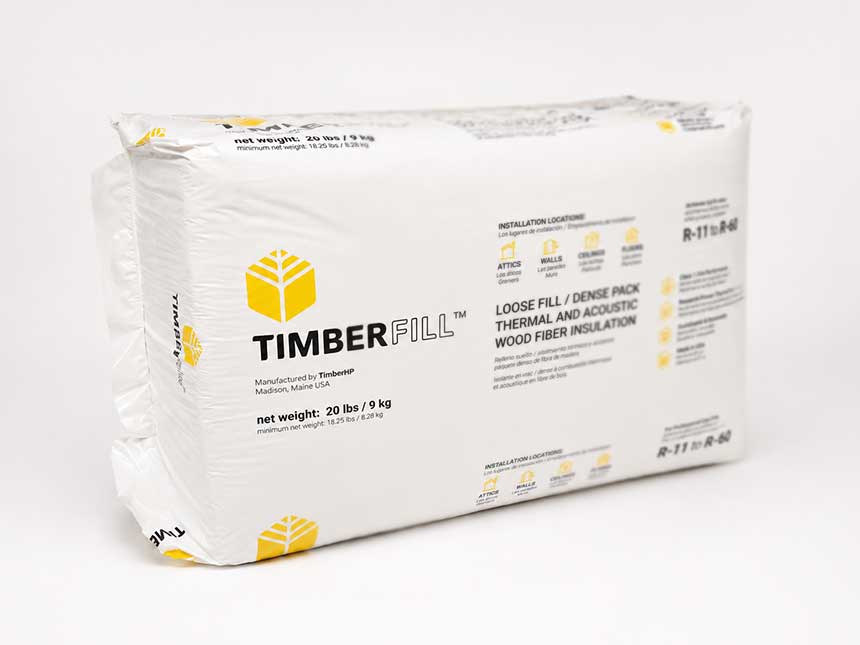
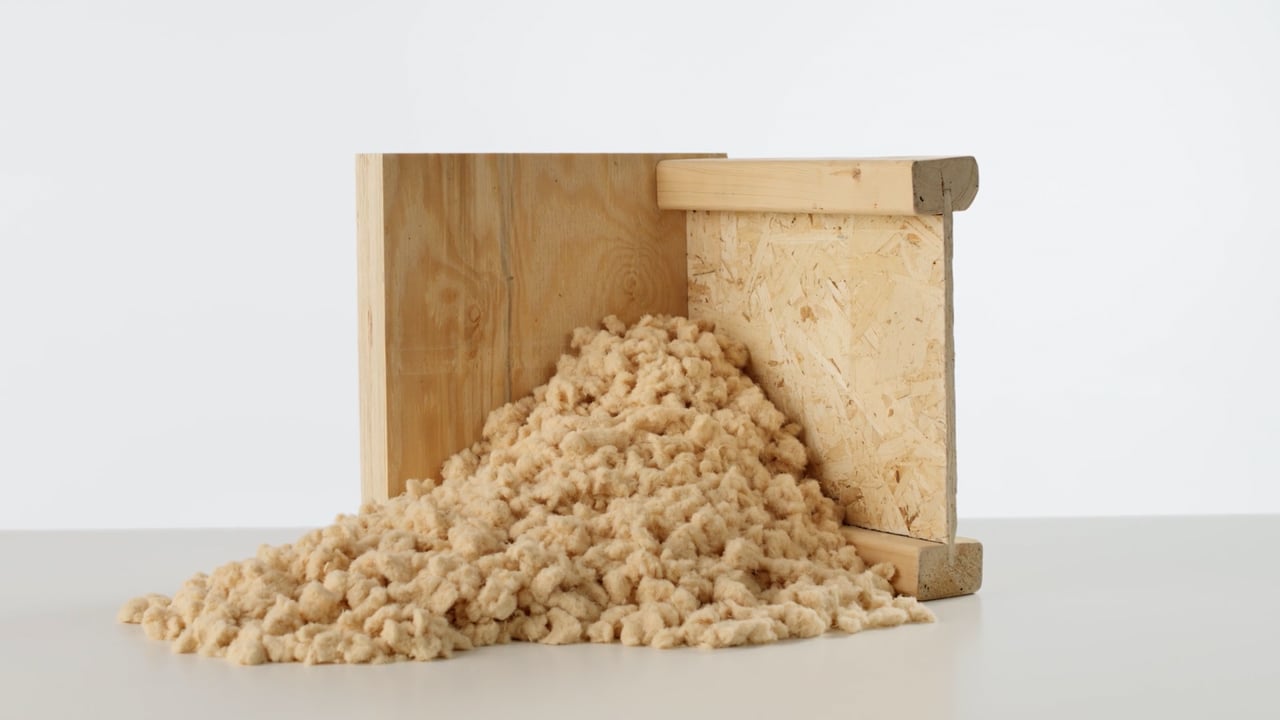
TimberFill is a debris-free wood fiber insulation for loose fill, dense pack, and blanket applications. With strong moisture buffering, acoustic performance, and settling resistance, TimberFill protects the building envelope by helping regulate temperatures and humidity – even in the toughest climates.








On this page:
A Moisture-Managing Alternative to Cellulose
TimberFill wood fiber insulation offers thermal performance, sound control, and vapor permeability, allowing roof and attic assemblies to manage moisture while maintaining energy efficiency. It can be used in both retrofit and new construction projects where building performance and material sustainability are important considerations.
Key Benefits of TimberFill Dense-Pack, Loose Fill, and Blanket Insulation
Moisture-Smart Assemblies: vapor-open wood fibers buffer and redistribute moisture within the assembly
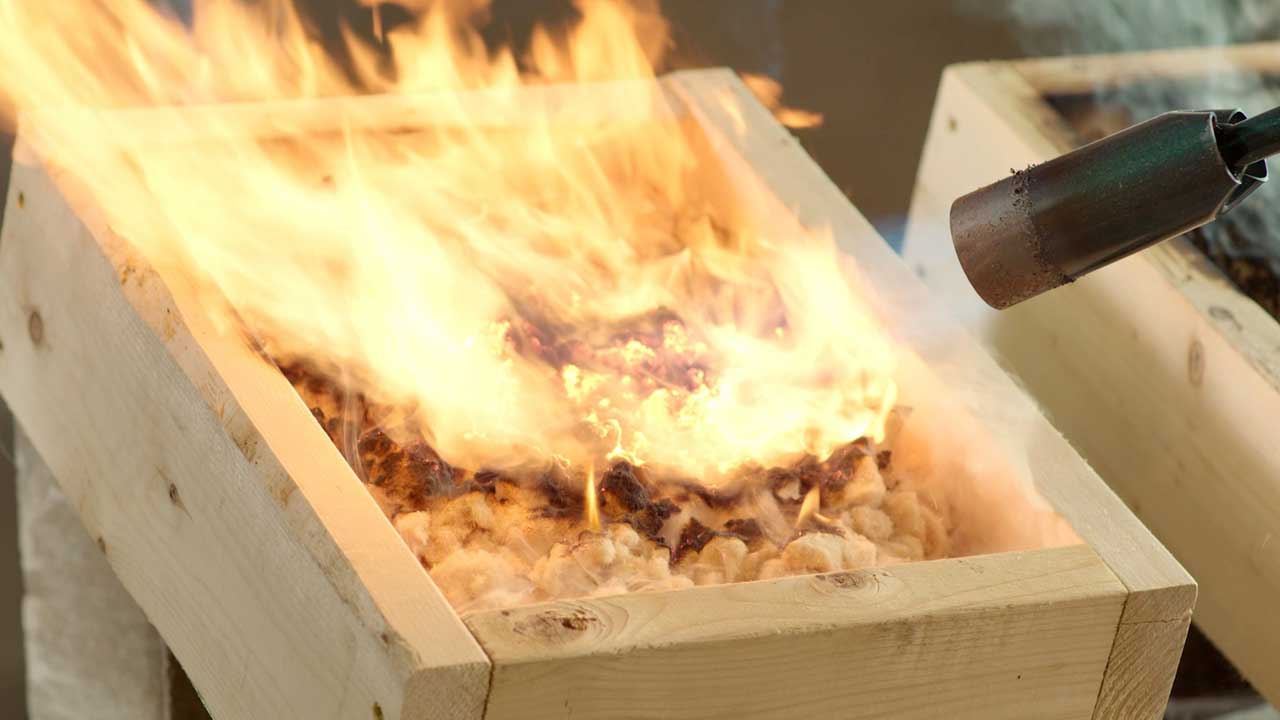
Class A Fire Performance: borate-treated to achieve ASTM E84 Class A fire performance

Complete Coverage: dense-pack and loose-fill applications fill walls, floors, ceilings and attics without gaps or voids
Built to Last: robust softwood fibers interlock to resist settling for reliable, long-term performance
Better Indoor Air Quality: GREENGUARD Certified, Red List Free and no added formaldehyde
Buildings That Give Back: made from residual softwood fiber, with low embodied carbon backed by a third-party verified EPD
Loose-Fill and Dense-Pack Insulation, Compared
| Category | TimberFill | Cellulose | Fiberglass Loose Fill |
|---|---|---|---|
| Moisture Management | Excellent Vapor Open + Buffers Moisture (Hygroscopic) | Good Vapor Permeable | Poor Must Stay Dry / Air Permeable, Low Density |
| Fire Resistance | Good Fire Resistant / Class A | Good Class A | Good Class A |
| Carbon Footprint (COâ‚‚e) | Excellent 90%+ Softwood Residuals / Carbon Negative | Good 75% Recycled Content / High Embodied Carbon | Good Some Recycled Glass / Moderate Embodied Carbon |
| Acoustics | Excellent STC 50–55 In tested assemblies | Good Superior Sound Absorption Good to excellent STC performance | Poor STC 32–38 Typical |
| Ease of Install | Excellent Fast Install / No Itch, No PPE Required | Good Fast Install / Itchy, PPE Recommended | Poor Can Compress or Slump / Very Itchy, PPE Required |
TimberFill Applications
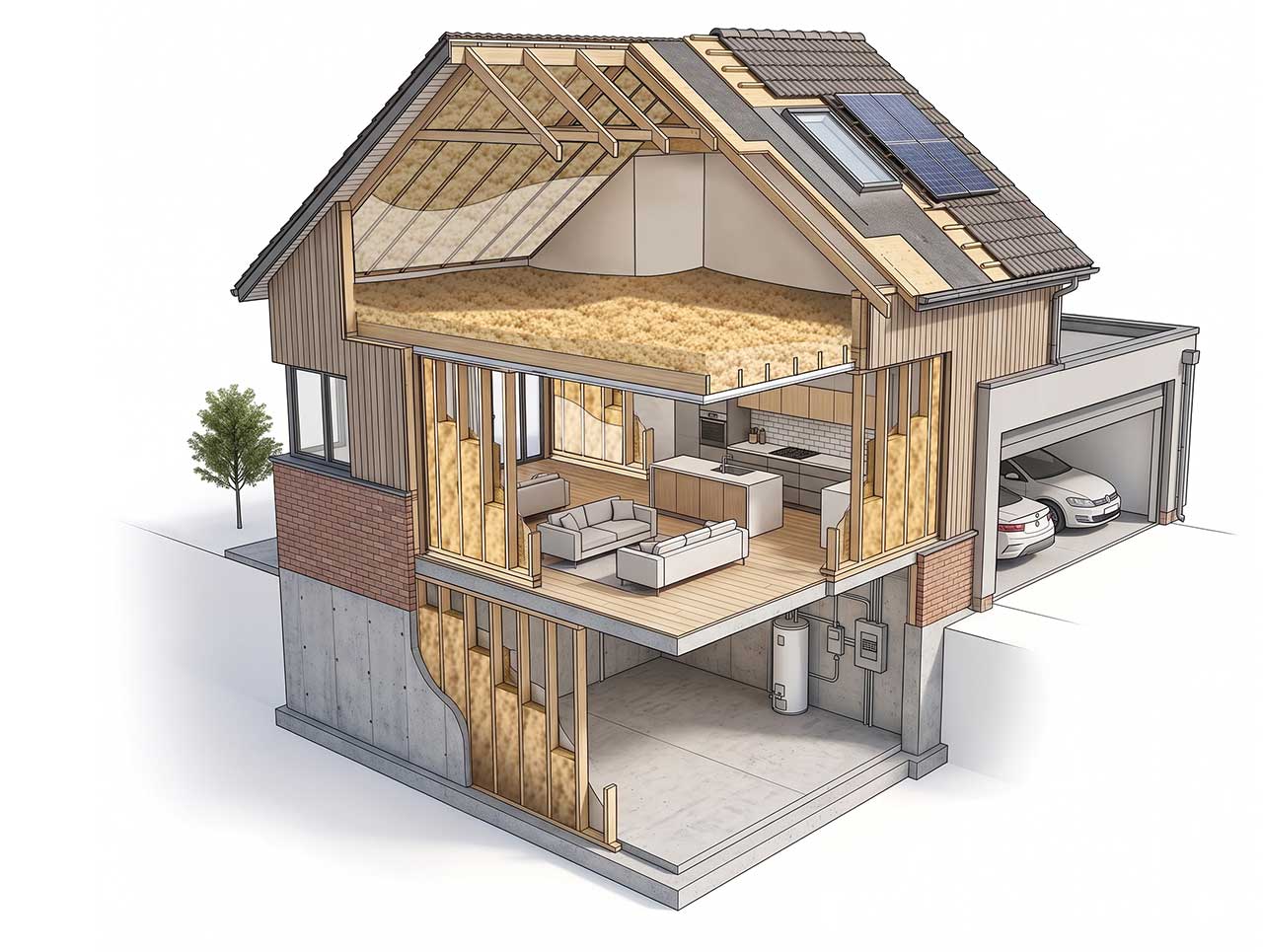
Click the blue pins to see how TimberFill works throughout a structure.Â

Floors, Ceilings, and Cavity Walls:
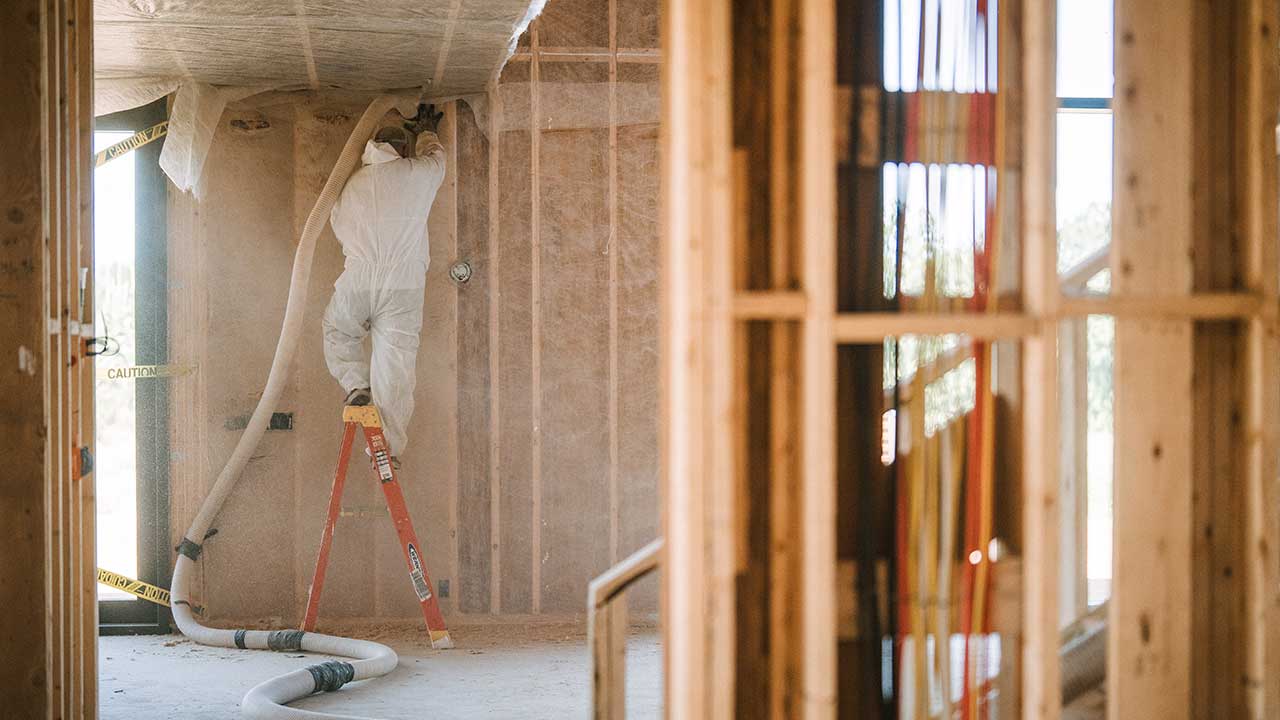
Dense-packed into cavities, TimberFill creates a high-performing, airtight thermal layer that controls temperature and humidity while reducing sound transmission across walls, floors, and ceilings.
Cathedral ceilings
TimberFill can be dense-packed into vaulted and cathedral ceiling cavities where there’s little or no attic space. If your rafters aren’t deep enough to meet your climate zone’s code-required R-value, add TimberBoard® above the roof deck to boost R-value, cut thermal bridging, and help control condensation in the cavity.
Project Highlights
Westbrook, Maine
Seavey Crossing Senior Apartments
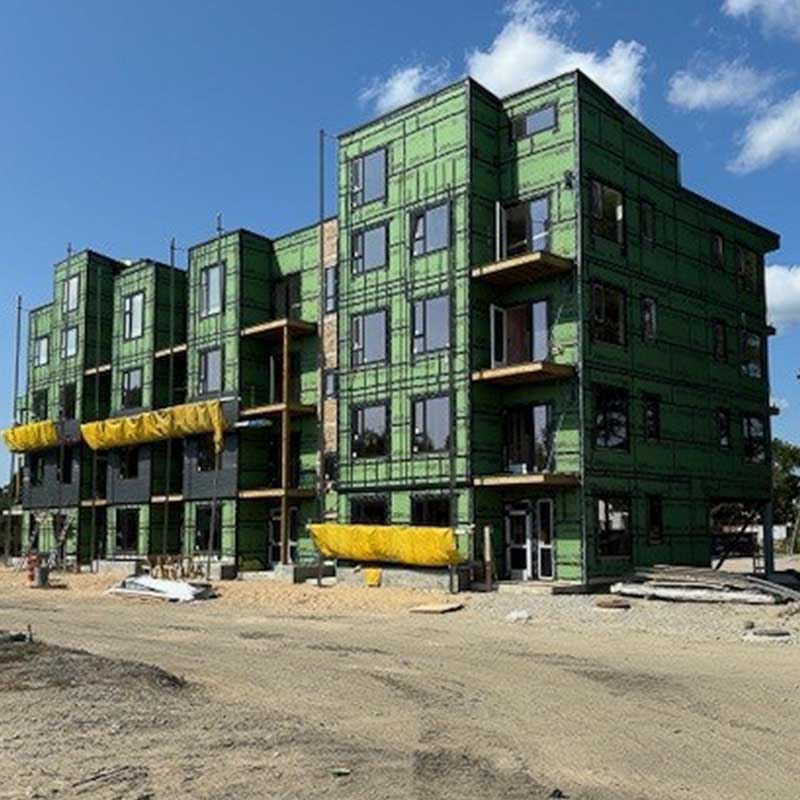
61,000 sq ft, 65 units, 5 stories
- Completion: Summer 2026
- Owner: AVESTA Housing / East Brown Cow Management
- Architect: Scott Simons Architects
- General Contractor: Hebert Construction
- Civil Engineer: St. Germain / Acorn Engineering
Seavey Crossing Senior Apartments brings 65 units of affordable senior housing to Westbrook, Maine. This design-build, wood-frame project pairs architecture by Scott Simons Architects with construction by Hebert Construction. TimberFill wood fiber insulation was specified for its thermal performance, acoustic comfort, and healthy indoor air quality–with sound dampening and fire-resistant properties well suited to multifamily construction and the tight energy budgets of affordable housing.

Concord, NH
Brookline Workforce Housing
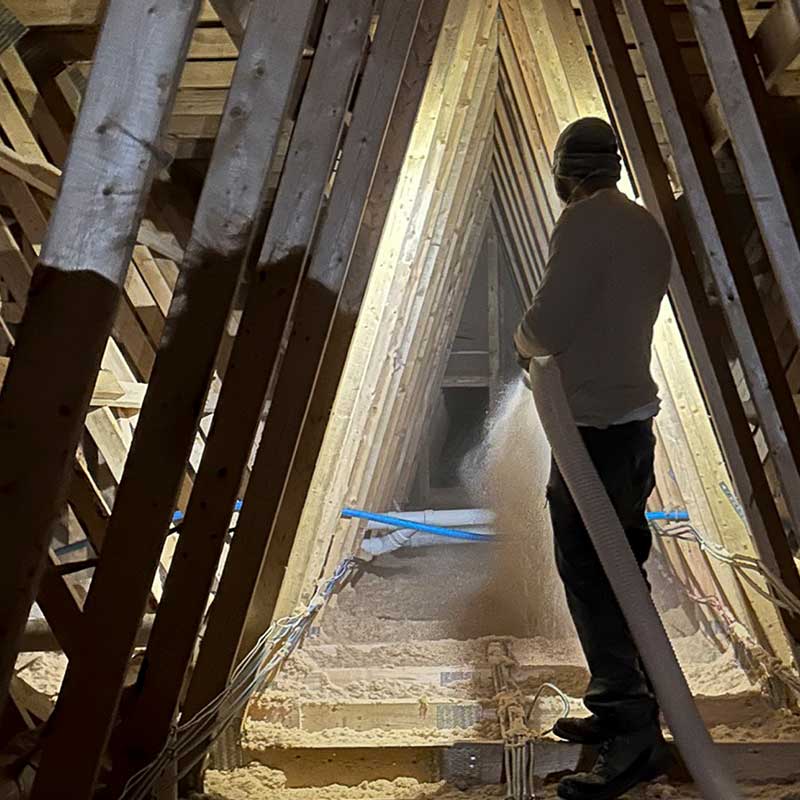
Open-blown attic insulation and dense-packed wall insulation installed in three buildings, 123 units, in Concord, NH.
- 53,670 sq ft R49 open-blown attic insulation
- 42,045 sq ft R21 dense-packed exterior walls
- Funded by Invest NH through the federal American Rescue Plan Act and Low Income Housing Tax Credits (LIHTC)
Builders chose TimberFill for the Brookline Workforce Housing initiative in Concord, NH–three buildings, 123 units. The team installed 53,670 sq ft of R49 open-blown attic insulation and 42,045 sq ft of R21 dense-packed wall insulation, delivering code-compliant, healthy, comfortable homes. Phase one brings affordability to 39 units: 31 at ≤60% AMI, 4 at ≤50% AMI, and 4 through the Section 811 PRA program (≤30% AMI) for individuals with severe mental illness.

TimberFill Performance Attributes

Dryer Walls, Built to Last
- Wood fibers naturally buffer and redistribute moisture as conditions change
- Vapor-open and breathable, allowing vapor to pass through wall assemblies rather than becoming trapped, helping to prevent mold, condensation, and rot
- Density and composition help resist airflow and wind washing, supporting consistent thermal performance
- Assemblies dry while maintaining superior thermal and acoustic performance

Quieter Homes, Peaceful Spaces
- Dense wood fibers absorb and dampen sound across a wide range of frequencies
- Tested assemblies achieve STC 50+ for quieter, more comfortable spaces
- Delivers industry-leading acoustic performance with NRC ratings up to 1.15 to absorb unwanted noise
- TimberFill dense-pack reaches STC 50 in a 2×4 wall with resilient channel, outperforming mineral wool (47) and fiberglass (46) batts in the same assembly

Buildings That Give Back
- Helps reduce operational carbon through generations of energy-efficient performance while reducing upfront emissions, storing carbon in the building envelope
- Made from residual softwood fiber, transforming a byproduct into long-lasting insulation
- Among the industry’s lowest embodied-carbon insulation materials, backed by a third-party verified EPD
Embodied Carbon (Default GWP) Kg COâ‚‚e / 100 ft2 at R=1
All values are from Building Emissions Accounting for Materials (BEAM), unless noted. Source: Builders for Climate Action
How to Install TimberFill Insulation
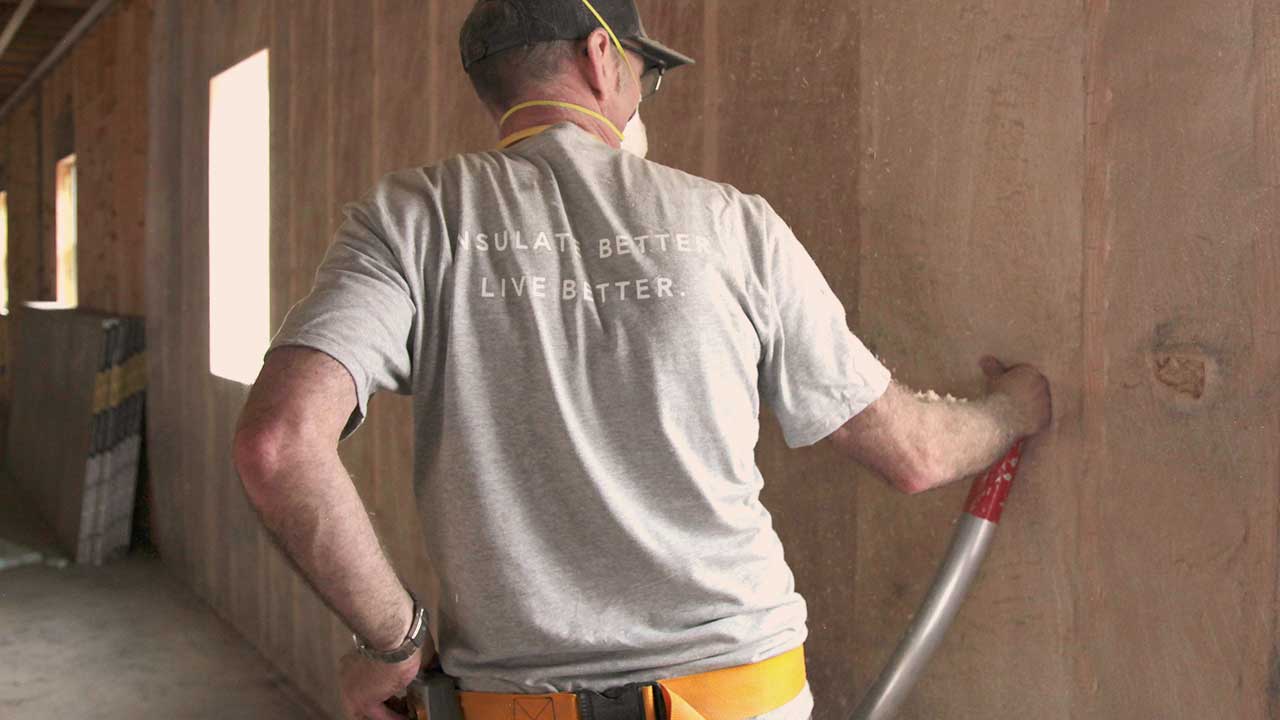
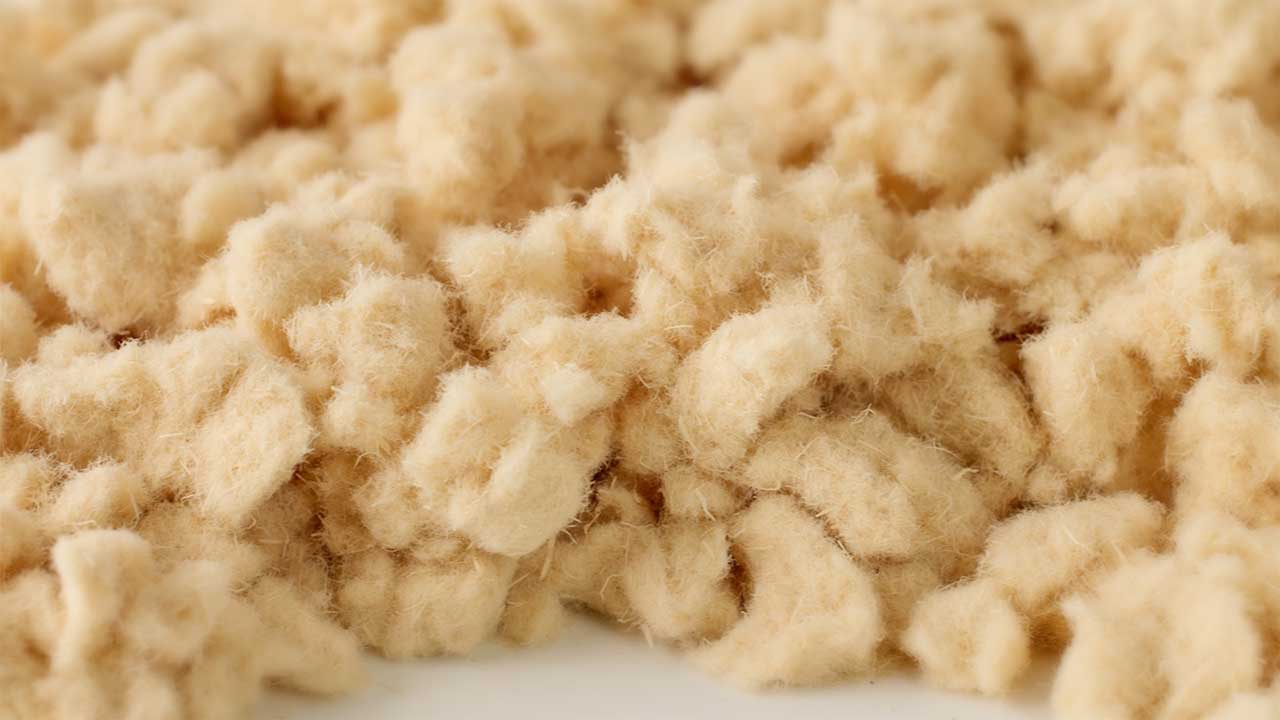
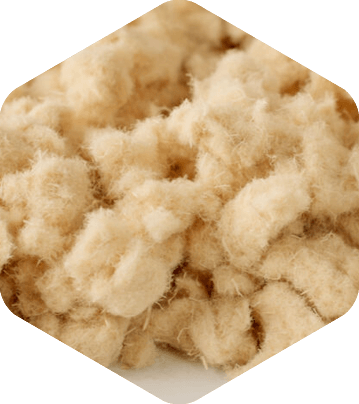
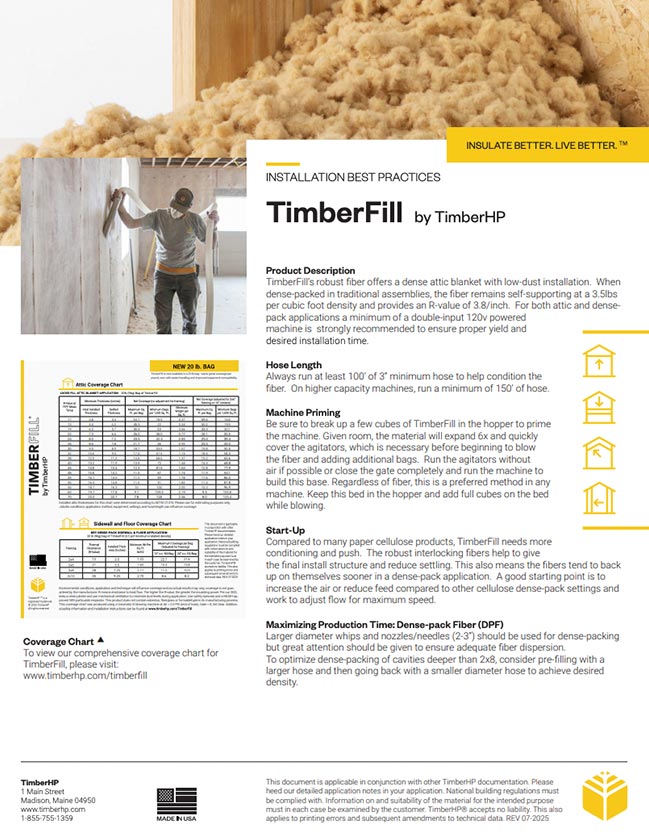
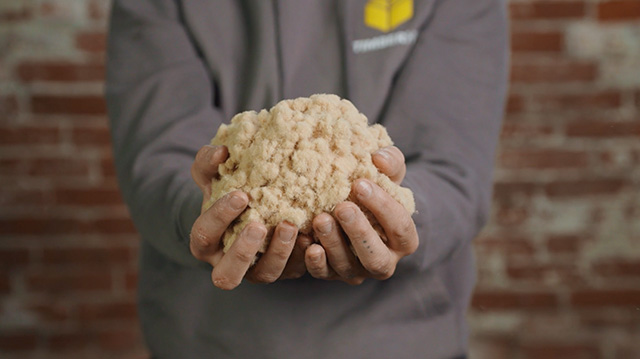
TimberFill is designed for ease of use on site. It’s minimally processed, yielding a long fiber length which lends to springiness. The size and shape of the fiber support increased coverage, reduced settling, and overall elevated performance.
- Unlike recycled or hardened products that leave debris or contaminants behind and can clog or strain blower motors, TimberFill runs through clean
- TimberFill is compressed for shipping and storage, and is conditioned through the blowing machine
- Once a self-supporting density is reached, TimberFill will remain in place for the lifetime of the application
Install Videos
Installation


Dense-Pack and Loose-Fill Application Charts
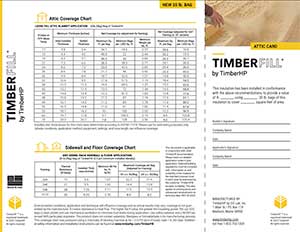
View Dense-Pack Chart
Dry Dense-pack Sidewall & Floor Application
20 lb (9kg) bag of TimberFill (3.5 pcf minimum installed density)
| Framing | Thermal Resistance (R-Value) | Installed Thickness (Inches) | Minimum Weight Per Sq. Ft. (lb/ft²) | Maximum Coverage per Bag (Adjusted for Framing) | |
|---|---|---|---|---|---|
| 16″ o.c. ft²/Bag | 24″ o.c. ft²/Bag | ||||
| 2×4 | 13 | 3.5 | 1.02 | 22.7 | 21.6 |
| 2×6 | 21 | 5.5 | 1.60 | 14.4 | 13.8 |
| 2×8 | 28 | 7.25 | 2.11 | 11.0 | 10.5 |
| 2×10 | 35 | 9.25 | 2.70 | 8.6 | 8.2 |
Dry dense-pack sidewall and floor application. 20 lb (9 kg) bag of TimberFill. Minimum installed density: 3.5 pcf.
View Loose- Fill Coverage Chart
Loose-Fill Attic Blanket Application
20 lb (9kg) bag of TimberFill
| R-Value at 75°F Mean Temp | Minimum Thickness (inches) | Net Coverage (No Adjustment for Framing) | Net Coverage (Adjusted for 2×6 Framing on 16″ Centers) | ||||
|---|---|---|---|---|---|---|---|
| Initial Installed Thickness | Settled Thickness | Maximum Sq. Ft. per Bag | Minimum Bags per 1,000 Sq. Ft. | Minimum Weight per Sq. Ft. | Maximum Sq. Ft. per Bag | Minimum Bags per 1,000 Sq. Ft. | |
| R-11 | 3.8 | 3.4 | 54.1 | 18.5 | 0.37 | 59.6 | 16.8 |
| R-13 | 4.4 | 4.0 | 45.5 | 22 | 0.44 | 50.2 | 19.9 |
| R-19 | 6.3 | 5.7 | 30.3 | 33 | 0.66 | 33.3 | 30.1 |
| R-22 | 7.3 | 6.6 | 26.0 | 38.5 | 0.77 | 28.1 | 35.5 |
| R-24 | 8.0 | 7.2 | 23.5 | 42.5 | 0.85 | 25.4 | 39.4 |
| R-26 | 8.6 | 7.8 | 21.7 | 46 | 0.92 | 23.3 | 43.0 |
| R-30 | 9.9 | 8.9 | 18.7 | 53.5 | 1.07 | 19.8 | 50.5 |
| R-32 | 10.6 | 9.5 | 17.4 | 57.5 | 1.15 | 18.4 | 54.3 |
| R-38 | 12.5 | 11.3 | 14.6 | 68.5 | 1.37 | 15.2 | 65.6 |
| R-40 | 13.2 | 11.9 | 13.9 | 72 | 1.44 | 14.5 | 68.8 |
| R-45 | 14.8 | 13.4 | 12.3 | 81.5 | 1.63 | 12.8 | 77.9 |
| R-48 | 15.8 | 14.2 | 11.5 | 87 | 1.74 | 11.9 | 84.1 |
| R-49 | 16.1 | 14.5 | 11.2 | 89 | 1.78 | 11.6 | 86.0 |
| R-50 | 16.5 | 14.8 | 11.0 | 91 | 1.82 | 11.4 | 87.8 |
| R-55 | 18.1 | 16.3 | 10 | 100 | 2.00 | 10.3 | 96.9 |
| R-60 | 19.7 | 17.8 | 9.1 | 109.5 | 2.19 | 9.5 | 105.8 |
| R-70 | 23.0 | 20.7 | 7.8 | 128 | 2.56 | 8.0 | 125.4 |
Installed attic thicknesses for this chart were determined according to ASTM C1374. Please use for estimating purposes only. Jobsite conditions, application method, equipment, settings, and hose length can influence coverage.
Frequently Asked Questions
Frequently Asked Questions About TimberFill Loose-Fill, Dense Pack, and Blanket Insulation: Q: What is TimberFill wood fiber insulation?
A: TimberFill® is an all-natural, blown-in wood fiber insulation made by TimberHP from sustainable softwood chips.
- Material: Crafted from abundant residual softwood chips blended with borate for fire, mold, and pest resistence.
- Performance: Offers an R-value of approximately R-3.4 per inch for loose fill and approximately R-3.8 per inch for dense pack, has low thermal conductivity, and exceptional acoustic sound dampening.
- Eco-Friendly: Backed by a third-party verified EPD, TimberFill is carbon-negative, meaning it stores more carbon than is emitted to make it.
- Supports healthier indoor air quality with GREENGUARD Certification, low VOCs, Red List Free ingredients and no added formaldehyde.
- Application: Versatile for attics, walls, floors, and ceilings using professional insulation blowers
Q: Can TimberFill be used in both new construction and renovations?
A: Yes. TimberFill works in both new construction and renovation. it can be open-blown as a loose-fill attic blanket or dense-packed into enclosed wall, flor, and ceiling cavities. Its used in single-family homes as well as commercial interiors, multifamily housing, schools, and offices.
Q: What’s the difference between TimberFill loose fill and dense-pack insulation?
A: TimberFill loose fill and dense-pack insulation are designed for different applications and installed at different densities. Loose-fill TimberFill is typically blown onto horizontal or sloped attic floors as an attic blanket, while dense-pack TimberFill is installed into enclosed wall, floor, and ceiling cavities at a higher density to create a stable, high-performance insulation layer. Loose-fill TimberFill provides approximately R-3.4 per inch at 75°F mean temperature, while dense-pack TimberFill installed at 3.5 lb/ft³ provides approximately R-3.8 per inch. The appropriate application depends on the assembly, desired R-value, and project requirements.
Q: What type of insulation blower is needed to install TimberFill?
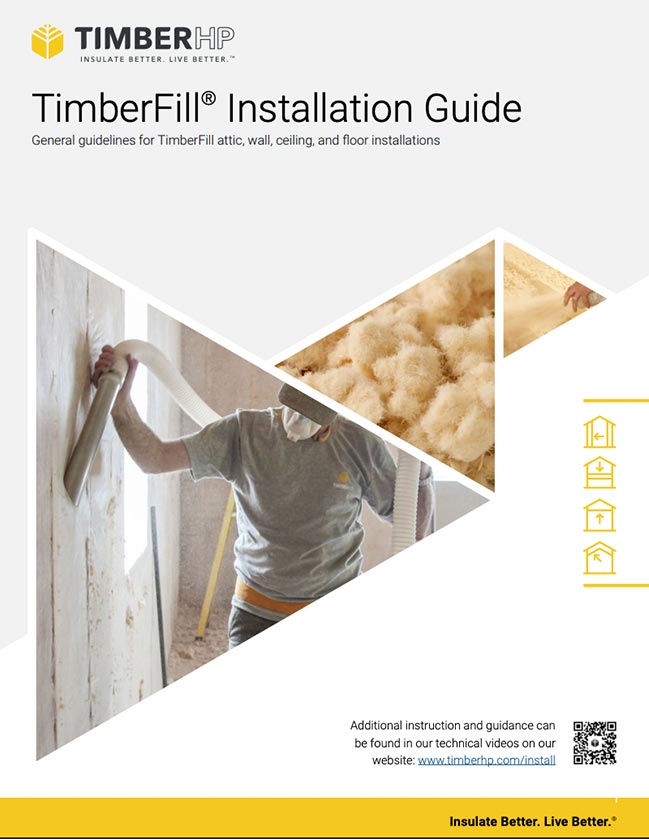
A: Loose-fill attic aapplications can be installed with most insulation blowing machines, including rental-class units. Dense pack is different. TimberFill's robust wood fibers need more conditioning and airflow than paper-based cellulose, so dense pack requies a professional-grade machine: at minimum a double-input, 120V unit. Small single-blower rental macines should be used for open attic installs only, never dense pack. Uase at least 100feet of 3-inch hose for all installs, and at least 150feet of higher-capacity machines. Recommended marchines aren starting settings are in our Installation Guide.
Q: How dense does TimberFill need to be for dense-pack insulation?
A: TimberFill dense-pack insulation should be installed at the density specified for the application to achieve its intended thermal performance and resistance to settling. TimberHP's evaluated dense-pack applications use densities ranging from 3.0 to 4.0 lb/ft³, with approximately R-3.8 per inch at 3.5 lb/ft³. Installers should use the appropriate coverage chart and installation guidance for the framing cavity and verify that the installed material meets the required density rather than relying solely on the number of bags used. To check density on site, weigh a box of known volume empty and then filled with TimberFill, and divide the weight difference by the box volume to get lb/ft3. Proper density is especially important in deeper cavities where installation technique and hose selection can affect fiber distribution.
Q: How much TimberFill do I need for my insulation project?
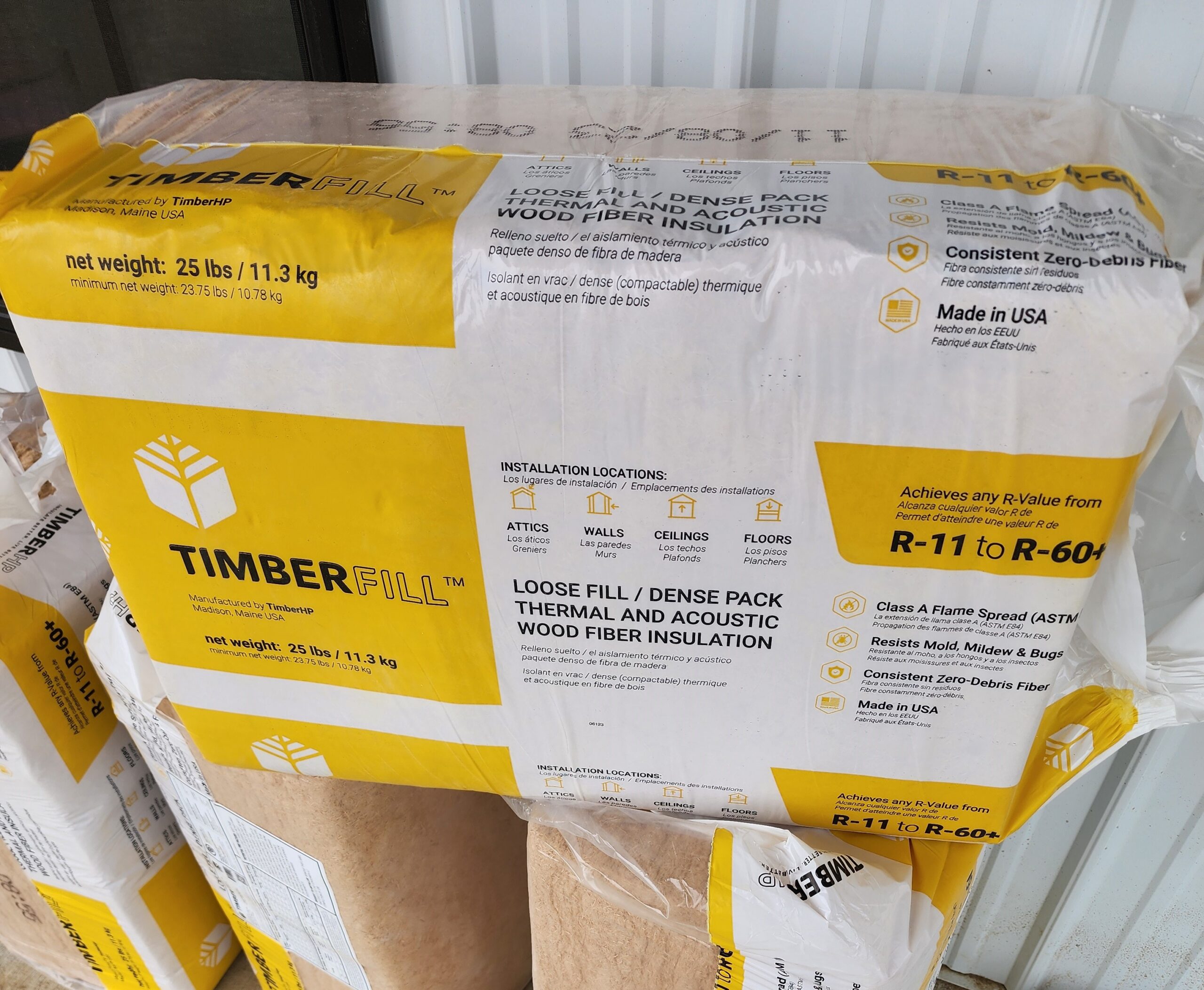
A: The amount of TimberFill required depends on the application, cavity dimensions, target R-value, installed density, framing, and project area. TimberHP provides coverage charts for both loose-fill attic blanket and dense-pack applications based on its current 20-pound bags (42 bags per pallet), and its online Blown-In Insulation Calculator can be used to estimate the material required for a project. Installers should use the applicable coverage chart rather than relying on a generic bags-per-square-foot calculation because actual coverage can vary with equipment, environmental conditions, application technique, and framing. TimberFill's former 25-pound bag was discontinued on July 14, 2025, so installers should confirm bag weight before calculating material requirements.
Q: Can TimberFill be used in deep wall or floor cavities?
A: Yes. TimberFill dense-pack insulation can be used in wall and floor cavities deeper than standard 2×6 construction, provided the application is installed according to TimberHP’s requirements for density, equipment, and fiber distribution. For deeper cavities, TimberHP recommends using larger-diameter hoses for pre-filling and then switching to a smaller-diameter hose to help achieve the desired density and fiber distribution. The current coverage chart provides dense-pack guidance for 2×4, 2×6, 2×8, and 2×10 framing depths.
Q: Does TimberFill meet building codes?
A: Yes. TimberFill is evaluated by ICC-E under ESR-5203 for compliance with the 2015, 2018, and 2021 International Building Code (IBC) and International Residential Code (IRC).
Q: Is TimberFill fire resistant?
A: Yes. Borate-treated TimberFill is rated ASTM E84 Class A, with a flames spread index of 25 or less and a smoke-developed index of 450 or less. Per ICC-ES ESR-5203, dense-packing wood-stud walls with TimberFill at the specified density adds 15 minutes to the wall’s fire-resistance rating under IBC Table 722.6.2(5).
Q: Can TimberFill be installed around recessed lights?
A: Keep TimberFill at least 3 inches away from recessed light fixtures and other heat-producing elements, unless the fixture is IC-rated or the element is listed for zero clearance (ICC-ES ESR-5203). Don’t block code-required attic ventilation.


Attic Blanket:
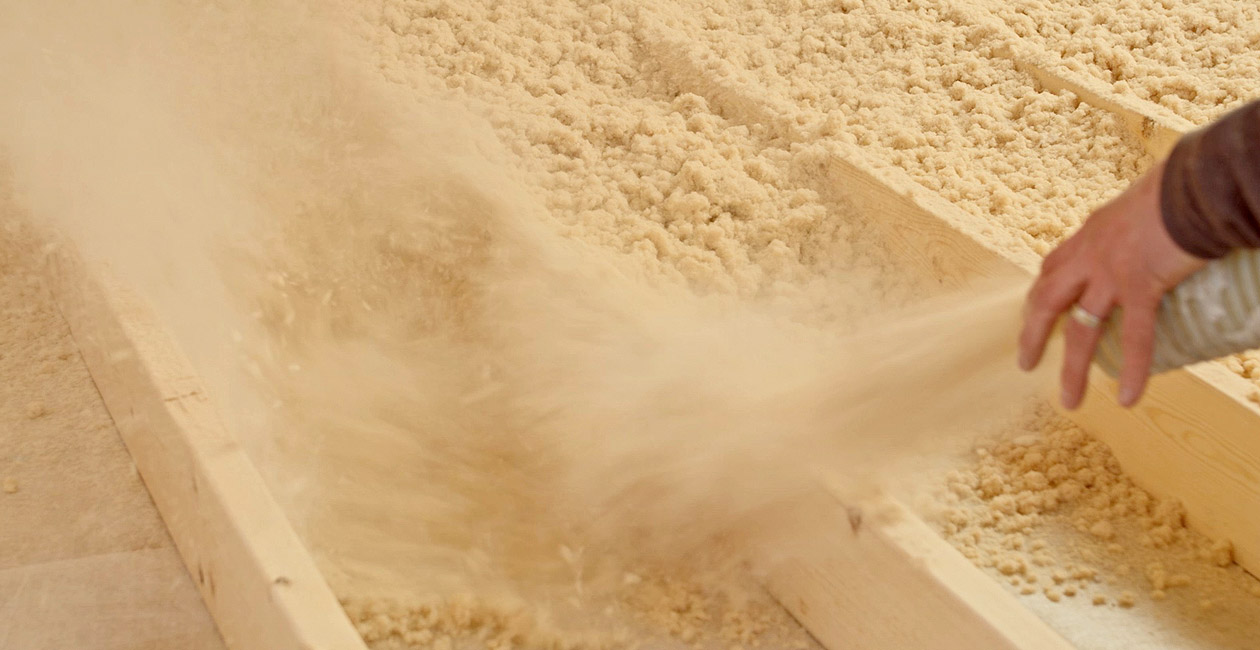
As a loose fill attic insulation, TimberFill provides seamless coverage and exceptional thermal performance, helping protect the building envelope by regulating attic temperatures year-round while allowing moisture to escape naturally.