
Blown-In Insulation Calculator
Estimate with Confidence
Our easy-to-use TimberFill blown-in wood fiber insulation calculator factors in your target R-value and area square footage to accurately estimate the number of 20lb bags you’ll need for your next project.
Calculator results are based on testing using a Volumatic III blowing machine at Air = 2.0 PSI (end of hose), Gate = 8, 3rd Gear. Actual coverage may vary based on environmental conditions, application and technique and is not guaranteed by the manufacturer. Install to the manufacturer’s specified density and depth to achieve the intended R-value, and verify coverage and thickness during installation. For estimating purposes only.
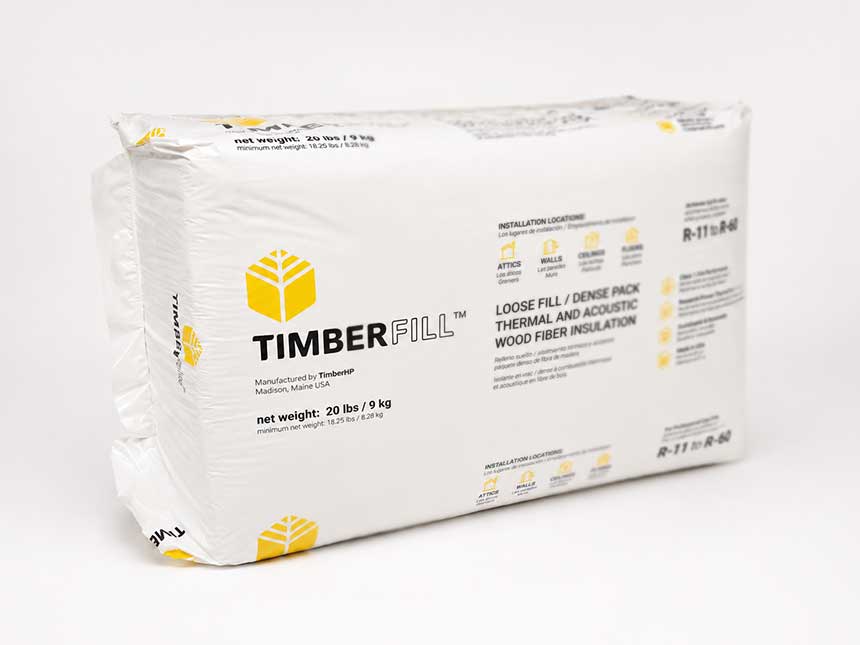
TimberFill is debris-free dense pack and loose fill wood fiber insulation. Fire-resistant, vapor-open and safe to handle.
FAQ
Everything You Need to Know About TimberFill
Get answers to common questions about TimberFill’s wood fiber dense-pack or loose fill insulation performance, applications, installation, and code compliance.
Q: What is wood fiber insulation?
A: Wood fiber insulation is a high-performance building insulation manufactured from renewable wood fibers sourced from sustainably managed forests. Unlike conventional insulation materials, wood fiber helps regulate heat, manage moisture, reduce sound transmission, and store carbon—all while supporting healthier, more durable building assemblies.
Q: Is wood fiber insulation fire-resistant?
A: Yes, TimberFill and all TimberHP wood fiber insulation products are fire resistant. TimberFill achieves a ASTM E84 Class A rating for flame and smoke spread – the highest fire resistance rating for building materials – and is treated with liquid borate, which saturates the wood fiber and provides a superior long-term solution for fire, bug, and moisture/mold resistance.
Q: Does wood fiber insulation prevent moisture and mold?
A: TimberHP insulation helps manage moisture by allowing wall and roof assemblies to dry naturally while resisting bulk water intrusion. This vapor-open approach reduces the risk of trapped moisture that can contribute to mold, rot, and premature building deterioration. Proper moisture management is one of the key reasons builders choose wood fiber insulation for high-performance building envelopes.
Q: Why are architects and builders choosing wood fiber insulation?
A: Architects and builders are increasingly specifying wood fiber insulation because it addresses multiple building performance goals with a single solution.
TimberHP helps improve:
- Energy efficiency
- Moisture management
- Acoustic performance
- Indoor comfort
- Building durability
- Sustainability
- Embodied carbon reduction
As building codes continue to evolve and demand grows for healthier, lower-carbon construction, wood fiber insulation provides a building science-based solution that supports long-term performance.
Q: Is wood fiber insulation better than fiberglass?
A: The best insulation depends on your project goals, but wood fiber insulation offers several advantages beyond thermal performance.
Compared to fiberglass, TimberHP wood fiber insulation provides:
- Better moisture management through vapor-open construction
- Superior sound absorption
- Improved thermal comfort during changing outdoor temperatures
- Renewable, bio-based materials
- Lower embodied carbon
- Comfortable installation without fiberglass irritation
While fiberglass focuses primarily on R-value, wood fiber insulation is designed to improve the overall performance and durability of the building envelope.
Q: What Is the best insulation for attic replacement projects?
A: The best insulation for an attic replacement project depends on factors such as thermal performance, air sealing strategy, moisture management, and long-term durability. Dense-pack insulation is commonly used in attics because it fills gaps and irregular spaces while helping reduce air movement within the assembly. Wood fiber dense-pack or loose fill insulation offers thermal performance, sound control, and vapor permeability, allowing roof and attic assemblies to manage moisture while maintaining energy efficiency. It can be used in both retrofit and new construction projects where building performance and material sustainability are important considerations.
Q: What code compliance does TimberFill meet?
A: TimberFill meets IRC and IBC insulation requirements and ASTM fire and vapor standards. For third-party testing documentation, see downloads.
Q: Can I use TimberFill wood fiber insulation in commercial construction?
A: Absolutely. TimberFill is well suited for commercial interiors, as well as multifamily housing, schools, and offices. Reach out to our team for assemblies and detailing support.