

The cyclones are going up outside the mill, and the batt line oven is nearly assembled! We hope you enjoy these March snapshots documenting recent progress taking place at TimberHP in Madison.


The cyclones are going up outside the mill, and the batt line oven is nearly assembled! We hope you enjoy these March snapshots documenting recent progress taking place at TimberHP in Madison.
The cyclones are going up outside the mill, and the batt line oven is nearly assembled! We hope you enjoy these March snapshots documenting recent progress taking place at TimberHP in Madison.
The house I’m referencing is not the one you live in, but the one we all live on, our planet. The historically bad year for wildfires in the west—where the season and frequency of large fires continue to grow—is bringing ecologists and forestry professionals together to find solutions to disrupt the path we’re on. There’s no doubt we’re heating […]

The house I’m referencing is not the one you live in, but the one we all live on, our planet.
The historically bad year for wildfires in the west—where the season and frequency of large fires continue to grow—is bringing ecologists and forestry professionals together to find solutions to disrupt the path we’re on.
There’s no doubt we’re heating up the planet. Scientists have known this for some time now and the need to act grows more urgent by the day.
There are solutions right in front of us: switching from fossil fuels to renewables; focusing on electrification; reducing demands for heating and cooling with plain old energy efficiency upgrades that utilize sustainable, carbon negative insulation products like TimberHP.
But what about the fires? Fire is scary. A catastrophic wildfire even more so.
Prescribed burns can reduce their impact. It’s a practice that’s gone on for centuries. But unfortunately, the ideal weather conditions required to do them safely are becoming less frequent also due to climate change. For our 80 million acres of national forests, logging and thinning must be part of the solution.
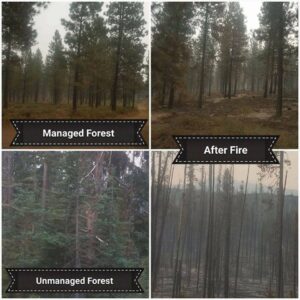
TimberHP, our line of carbon storing, wood fiber insulation, is also part of this solution.
The feedstock we use to make our loose fill, stud-cavity batt and exterior board products comes from residual wood chips from lumber production, and from the low grade softwood generated dur sustainable forestry practices. Working with our partners in the saw mills and the woods, we purchase this material and turn it into TimberHP wood fiber insulation.
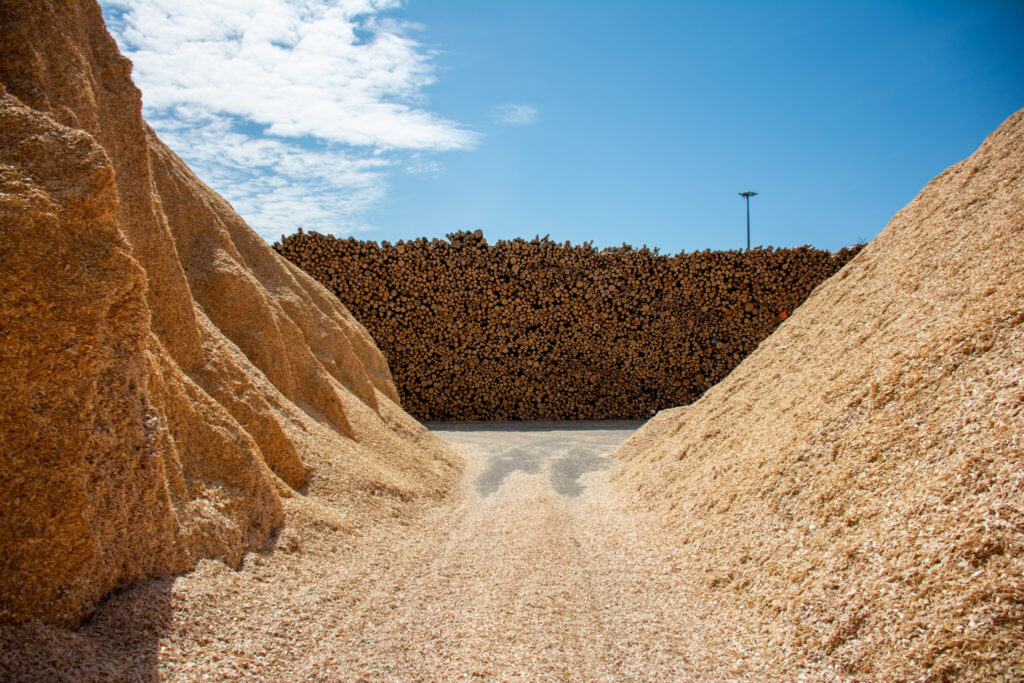
Once established in the Northeast market, TimberHP intends to expand to other locations across the country and out west, we’re confident we can be part of the solution, as the region looks for a multi-dimensional strategy to break the cycle of catastrophic wildfires.
We look forward to working with future friends and partners to address this urgent problem.
TimberHP—Insulate Better. Live Better. TM
“After several years of planning and preparation, a defunct paper mill in Madison has come roaring back to life with a new product: high-performance wood fiber insulation for homes and other buildings,” writes J. Craig Anderson in an update on TimberHP’s progress for Mainebiz. “It’s a different type of insulation than anyone has seen in […]
“After several years of planning and preparation, a defunct paper mill in Madison has come roaring back to life with a new product: high-performance wood fiber insulation for homes and other buildings,” writes J. Craig Anderson in an update on TimberHP’s progress for Mainebiz.
“It’s a different type of insulation than anyone has seen in America,” said company co-founder and CEO Joshua Henry, adding that retailers and distributors have expressed strong interest. “They’re quite eager to get their hands on that product.”
TimberHP is one of four companies profiled in a recent feature story in The Architect’s Newspaper on the role rural America’s farms, forests and factories are playing in the creation of new carbon storing building materials. “You have an insulation market with no knowledge of the forest market, and a forest market with no knowledge […]
TimberHP is one of four companies profiled in a recent feature story in The Architect’s Newspaper on the role rural America’s farms, forests and factories are playing in the creation of new carbon storing building materials. “You have an insulation market with no knowledge of the forest market, and a forest market with no knowledge of the insulation market,” Scott Dionne, TimberHP’s chief of marketing, notes in the piece. “You need someone to go in there and say, ‘There’s a gap. And this solves problems on both sides.’”
The architecture and design team at Maine Homes is out with their list of top design and sustainability trends for the coming year. It’s an annual compilation that highlights hot trends in the field and how those themes are being represented in the work of individuals and businesses with ties to Maine’s architecture and design […]
The architecture and design team at Maine Homes is out with their list of top design and sustainability trends for the coming year. It’s an annual compilation that highlights hot trends in the field and how those themes are being represented in the work of individuals and businesses with ties to Maine’s architecture and design communities.
We’re thrilled that wood fiber insulation and TimberHP made the list, which you can read in its entirety here: Maine Homes list
Wood fiber insulation boards do many things well. One of them, it turns out, is helping to protect roofs on old, Cape-style homes from ice dams. The often shoddy building envelopes in these charming old houses allow warm air to reach the roof sheathing, where it initiates the winter cycle of thawing and refreezing that causes ice […]
Wood fiber insulation boards do many things well. One of them, it turns out, is helping to protect roofs on old, Cape-style homes from ice dams. The often shoddy building envelopes in these charming old houses allow warm air to reach the roof sheathing, where it initiates the winter cycle of thawing and refreezing that causes ice dams. A story in the year-end edition of Fine Homebuilding tells the story of a roof replacement on an old cape in Vermont. By using a continuous exterior layer of wood fiber boards imported from Europe, along with blown cellulose, a taped air barrier and improved passive ventilation, the construction team ensures that the new roof assembly can meet the harsh demands of a New England winter!
For the month of November, we completed a lot of exterior work. There was heavy duty asphalt placed for the chip receiving areas. Blend chamber and dryer tube steel was erected and is now completed. Dryer cyclone steel was delivered and the first levels of that were also put up. Rooftop heating units for the […]
For the month of November, we completed a lot of exterior work. There was heavy duty asphalt placed for the chip receiving areas. Blend chamber and dryer tube steel was erected and is now completed. Dryer cyclone steel was delivered and the first levels of that were also put up. Rooftop heating units for the mill were installed and tested, now running full time heating to keep the building warm for concrete placements on the operating floor.
Several small concrete placements were completed on the operating floor, as well as work preparing the large floor opening for its first concrete pours that will happen in December and January. Refiner area trench work was completed and foundation work in that area began. Piping and cabling work continues in side the mill. Chip handling equipment was all placed except for the full truss conveyor that is being placed in the very near future.


To us at TimberHP, that question sounds a bit like “why breathe air?” or “what good are flowers anyway?”
To us at TimberHP, that question sounds a bit like “why breathe air?” or “what good are flowers anyway?”
Continue reading “Why Wood Fiber?”We were excited to welcome Passivhaus Maine to TimberHP headquarters earlier in November for a special day of education, product demonstrations and tours.
We were excited to welcome Passivhaus Maine to TimberHP headquarters earlier in November for a special day of education, product demonstrations and tours.
Continue reading “TimberHP Hosts Passivhaus Maine in Madison”The TimberHP marketing and sales team had a great call recently with a writer for Building Green based in Brattleboro, VT.
The TimberHP marketing and sales team had a great call recently with a writer for Building Green based in Brattleboro, VT.
Continue reading “Can U.S.-made Wood Insulation Go Mainstream?”