


Acoustic Performance
QUIETER SPACEs, BETTER COMFORT
TimberHP wood fiber insulation helps reduce airborne sound transmission through its dense, porous fiber structure, creating quieter interior environments.

Tested Performance You Can Trust
The following assembly ratings are based on third-party testing conducted by Riverbank Acoustical Laboratories (RAL), providing architects, builders, and designers with trusted data for specifying high-performance wall assemblies using TimberHP insulation.
Acoustic performance is evaluated using STC and OITC ratings to measure sound transmission between spaces, and NRC to measure sound absorption within a space. Together, these metrics provide a comprehensive view of acoustic performance, helping create quieter, more comfortable buildings.
Why AssemblIES MATTER
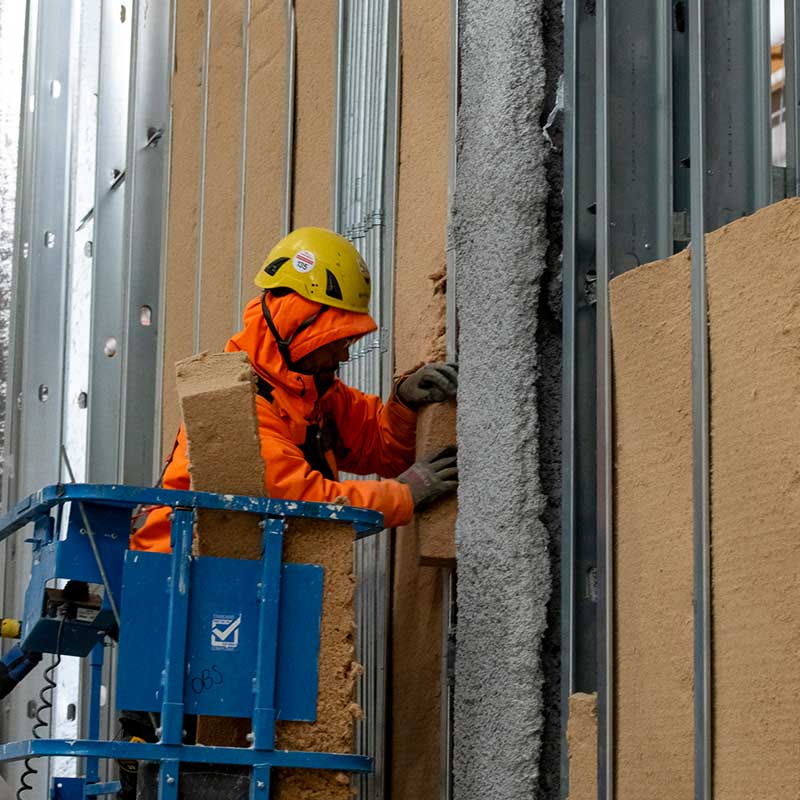
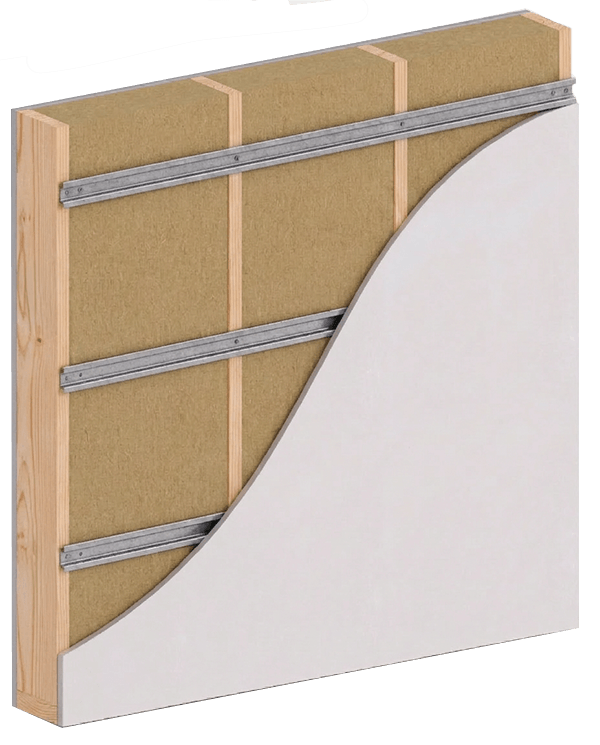
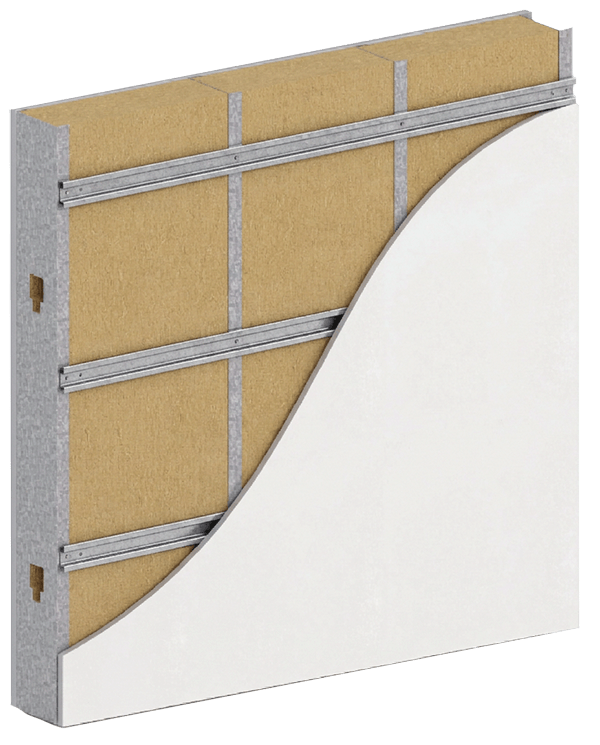
Acoustic performance is determined by the complete wall assembly—including framing, insulation, gypsum layers, resilient channels, and air sealing details. While insulation is just one component, third-party testing demonstrates that TimberBatt contributes to high-performing assemblies. The examples below compare STC ratings for similar wall assemblies using different cavity insulation materials.

2×4 Wood Stud Cavity
Understanding STC Ratings
Sound Transmission Class (STC) is the industry-standard rating used to measure how effectively a wall, floor, or ceiling assembly reduces airborne sound.
The higher the STC rating, the more sound is blocked.
| STC Rating | What You Hear |
|---|---|
| 30 | Speech easily understood |
| 40 | Speech difficult to understand |
| 50 | Great sound isolation. Speech heard only as a murmur |
| 60+ | Excellent sound isolation |
Even small increases in STC can noticeably improve privacy and occupant comfort. A 10-point increase is generally perceived as roughly cutting sound transmission in half.
Ready to Build a Quieter Space?
WOOD STUD ASSEMBLIES
All assemblies tested by Riverbank Acoustical Laboratories (RAL) in accordance with ASTM E90 and ASTM E413. Results apply only to the assemblies shown.
| RAL Test # | Framing | Insulation | Insulation Thickness | Resilient Channel | Drywall | STC | OITC |
|---|---|---|---|---|---|---|---|
| TL23-011 | 2×4 Wood Studs 16" o.c. | TimberBatt | 3" | No | 5/8" Type X Both Sides | 37 | 27 |
| TL23-012 | 2×4 Wood Studs 16" o.c. | TimberBatt | 3" | Yes | 5/8" Type X Both Sides | 50 | 31 |
| TL23-013 | 2×4 Wood Studs 16" o.c. | TimberFill | Full Cavity (3.5") | Yes | 5/8" Type X Both Sides | 50 | 32 |
| TL23-014 | 2×4 Wood Studs 16" o.c. | TimberFill | Full Cavity (3.5") | No | 5/8" Type X Both Sides | 37 | 27 |
| TL23-015 | 2×6 Wood Studs 16" o.c. | TimberBatt | 5.5" | Yes | 5/8" Type X Both Sides | 55 | 37 |
| TL23-016 | 2×6 Wood Studs 16" o.c. | TimberBatt | 5.5" | No | 5/8" Type X Both Sides | 36 | 28 |
| TL23-017 | 2×6 Wood Studs 16" o.c. | TimberFill | Full Cavity (5.5") | Yes | 5/8" Type X Both Sides | 53 | 38 |
| TL23-018 | 2×6 Wood Studs 16" o.c. | TimberFill | Full Cavity (5.5") | No | 5/8" Type X Both Sides | 38 | 28 |
STEEL STUD ASSEMBLIES
All assemblies tested by Riverbank Acoustical Laboratories (RAL) in accordance with ASTM E90 and ASTM E413. Results apply only to the assemblies shown.
| RAL Test # | Framing | Insulation | Insulation Thickness | Resilient Channel | Drywall | STC | OITC |
|---|---|---|---|---|---|---|---|
| TL23-007 | 3-5/8" Steel Studs 16" o.c. | TimberBatt | 3" | Yes | 5/8" Type X Both Sides | 53 | 34 |
| TL23-008 | 3-5/8" Steel Studs 16" o.c. | TimberBatt | 3" | No | 5/8" Type X Both Sides | 46 | 30 |
| TL23-009 | 3-5/8" Steel Studs 24" o.c. | TimberBatt | 3" | Yes | 5/8" Type X Both Sides | 53 | 32 |
| TL23-010 | 3-5/8" Steel Studs 24" o.c. | TimberBatt | 3" | No | 5/8" Type X Both Sides | 49 | 30 |

SOUND ABSORPTION PERFORMANCE
| Product Name | Thickness | NRC** | RAL Test # |
|---|---|---|---|
| TimberFill | 5-1/2 inch | 1.15 | A22-003 |
| TimberBatt | 5-1/2 in | 1.15 | A22-007 |
| TimberBoard (Single layer) | 1-1/2 inch | 0.85 | A22-004 |
| TimberBoard (Two layers) | 3 inch | 0.85 | A22-005 |
| TimberBoard (Single layer) | 5-1/2 inch | 1.00 | A22-006 |
Understanding NRC Ratings
Noise Reduction Coefficient (NRC) measures a material’s ability to absorb sound.
The higher the NRC rating, the more sound is absorbed.
Values above 0.80 are generally considered highly effective for acoustic control.
FAQ
Everything You Need to Know About TimberHP Acoustic Performance
Get answers to common questions about TimberHP’s acoustic performance, sound control capabilities, building applications, installation best practices, and code compliance.
Q: What is STC and why does it matter?
A: Sound Transmission Class is the industry-standard rating for how effectively a wall, floor, or ceiling assembly reduces airborne sound. The higher the number, the more sound is blocked between spaces.
Q: What’s the difference between STC and NRC?
A: STC and OITC describe how much sound an assembly blocks from passing through it. NRC describes how much sound a material absorbs within a room, reducing echo and reverberation. TimberHP wood fiber performs strongly on both.
Q: Is insulation the only thing that determines a wall’s STC?
A: No. Acoustic performance depends on the full assembly — framing type and spacing, insulation, number and type of gypsum layers, resilient channel, and air sealing. Every rating in this guide applies only to the exact assembly tested.
Q: Do TimberBatt and TimberFill perform differently?
A: Both are rated to an NRC of 1.15 at 5-1/2″. TimberBatt friction-fits for fast cavity installation; TimberFill dense-packs or blows in for full-cavity coverage in retrofit or irregular framing.
Q: Where can I see the raw test data?
A: Every assembly above references its Riverbank Acoustical Laboratories test number (e.g. TL23-007). The full Acoustic Performance Guide includes complete assembly drawings for each one.
Download the TimberHP Acoustic Performance Guide
Explore third-party tested wall assemblies featuring TimberBatt and TimberFill, with verified STC, OITC, and NRC data to help you design quieter, more comfortable, high-performance buildings.
THE WOOD FIBER ADVANTAGE
- Dense wood fibers help to absorb sound energy and block sound transmission for quieter buildings
- Achieve STC rating of 50+ and NRC rating up to 1.15
- Thermal and acoustic performance in one insulation layer
- Friction-fit installation helps reduce gaps and voids